
Industrial Hardware for Warehouse Operations
Industrial AIoT hardware including RFID, BLE, devices, LoRaWAN, cellular, wearable devices, dock devices, and warehouse tracking technologies.
Connected Hardware Technologies for Warehouse Systems
Warehouse and distribution facilities depend on reliable hardware to capture operational data from inventory, personnel, mobile equipment, loading docks, storage locations, and transportation assets. Every pallet movement, forklift journey, inventory transaction, dock operation, and worker activity creates valuable operational information that supports warehouse productivity, inventory accuracy, and order fulfillment.
WareDist AI provides industrial AI and IoT hardware technologies specifically designed for warehouse and distribution operations. These technologies combine RFID identification, Bluetooth Low Energy (BLE), industrial IoT devices, LoRaWAN connectivity, cellular communications, wearable devices, and intelligent edge hardware to provide continuous operational visibility across warehouse facilities.
Rather than functioning as isolated devices, warehouse hardware works together with AI software and warehouse management systems to collect accurate operational data from receiving, put-away, storage, replenishment, picking, packing, staging, shipping, returns processing, and yard operations. This connected approach enables warehouse operators to improve workforce coordination, monitor equipment utilization, strengthen inventory accuracy, and support faster operational decision making.
WareDist AI hardware is designed for distribution centers, third-party logistics facilities, manufacturing warehouses, cold storage operations, cross-docking facilities, automated fulfillment centers, spare parts warehouses, and high-density storage environments where dependable hardware performance is essential for continuous warehouse operations.
Industrial Hardware Built for Warehouse Operations
Warehouse environments require hardware capable of operating continuously under demanding industrial conditions. Equipment must perform reliably around forklifts, conveyor systems, pallet movements, varying temperatures, dust, vibration, wireless interference, and heavy daily usage.
WareDist AI supports industrial-grade hardware that delivers dependable performance while integrating with Warehouse Management Systems (WMS), Enterprise Resource Planning (ERP) software, warehouse automation equipment, industrial wireless networks, and AI-assisted operational software.
Hardware technologies support
- Workforce visibility
- Controlled warehouse access
- Asset identification
- Inventory monitoring
- Equipment tracking
- Dock activity monitoring
- Trailer visibility
- Environmental sensing
- Warehouse automation
- Operational data collection
These technologies provide the physical foundation that enables AI and IoT solutions to improve warehouse performance through continuous operational monitoring.
Enterprise AI and IoT Hardware Portfolio for Warehouse Operations
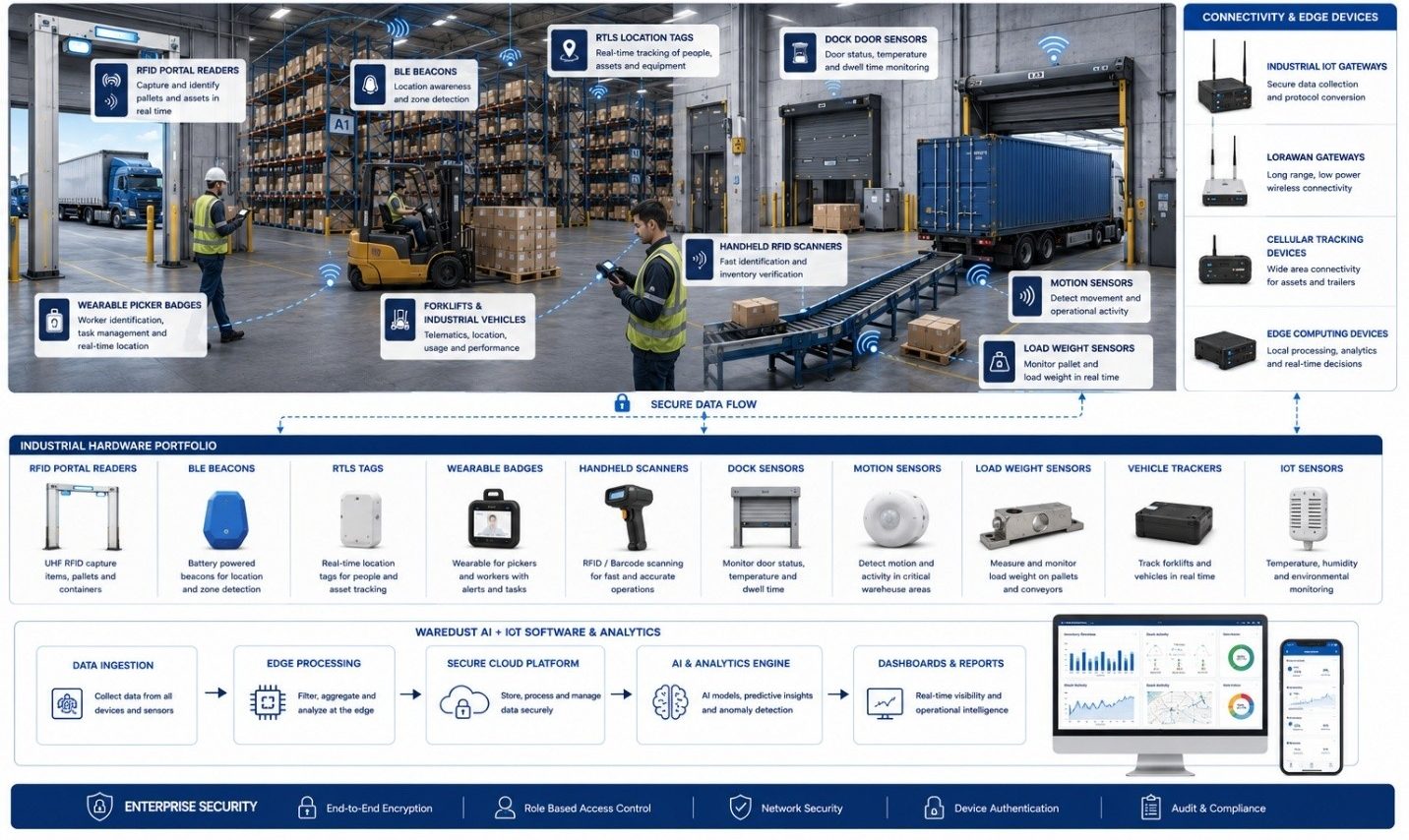
A premium enterprise illustration showcasing the complete AI and IoT hardware portfolio for intelligent warehouse operations. The visual features RFID portal readers, BLE beacons, wearable picker badges, handheld RFID scanners, dock door devices, forklifts, pallet racks, RTLS location tags, industrial gateways, LoRaWAN gateways, cellular tracking devices, motion devices, load weight devices, and edge computing devices. Secure operational data flows into centralized warehouse software and AI-powered dashboards, enabling real-time inventory visibility, asset tracking, workforce monitoring, predictive analytics, and operational system.
Hardware Applications Across Warehouse & Distribution Facilities
Warehouse hardware technologies support operational visibility throughout every stage of warehouse execution. Connected identification devices, industrial devices, wireless communications, and edge hardware continuously collect operational information that enables AI software to monitor warehouse performance and improve decision making.
Typical deployment environments include
- Regional distribution centers
- Third-party logistics facilities
- E-commerce fulfillment centers
- Manufacturing warehouses
- Cold storage facilities
- Spare parts warehouses
- High-density storage operations
- Cross-docking terminals
- Automated sortation centers
- Industrial distribution hubs
Hardware deployment strategies are tailored to warehouse layouts, storage density, operational workflows, inventory characteristics, and facility infrastructure to maximize data accuracy and wireless coverage.
Warehouse Floor Devices
Warehouse floor devices collect operational information directly from warehouse activities. These devices continuously identify inventory movements, monitor workforce locations, supervise dock operations, detect equipment movement, and provide the operational data required by AI analytics and warehouse software.
WareDist AI supports industrial devices that operate reliably across receiving areas, pallet storage zones, narrow aisles, picking locations, conveyor systems, packing stations, staging areas, shipping docks, and outdoor yard operations.
RFID Portal Readers
RFID portal readers automatically identify tagged pallets, containers, cartons, and warehouse assets as they move through dock doors, warehouse aisles, conveyor systems, and controlled operational zones.
RFID portal readers support
- Automated pallet identification
- Receiving verification
- Shipping confirmation
- Inventory movement recording
- Dock verification
- Warehouse transfer validation
- Asset visibility
- Operational event capture
Automated identification significantly reduces manual scanning while improving inventory accuracy throughout warehouse operations.
BLE Beacons & Tags
Bluetooth Low Energy technology enables continuous location awareness for warehouse personnel, forklifts, mobile assets, pallets, returnable containers, and warehouse equipment.
BLE devices support
- Personnel location monitoring
- Forklift positioning
- Mobile asset visibility
- Equipment utilization analysis
- Warehouse zone awareness
- Proximity detection
- Indoor positioning
- Operational movement history
BLE technology supports AI-assisted workforce analysis while improving operational coordination across warehouse facilities.
Wearable Picker Badges
Wearable smart badges provide warehouse personnel with reliable identification while supporting workforce visibility and operational safety.
Wearable badges can provide
- Personnel identification
- Shift validation
- Restricted area authorization
- Emergency personnel location
- Workforce activity monitoring
- Zone occupancy visibility
- Task assignment support
- Operational event recording
Wearable devices improve workforce accountability while supporting warehouse productivity and worker safety initiatives.
Dock Door Devices
Dock door devices continuously monitor loading dock activity throughout receiving and shipping operations.
Operational capabilities include
- Door open and closed status
- Trailer arrival detection
- Loading activity monitoring
- Dock occupancy reporting
- Shipment readiness confirmation
- Operational timing records
- Equipment utilization monitoring
- Dock performance analytics
Continuous dock monitoring improves receiving coordination while supporting higher warehouse throughput.
AI and RFID for Warehousing
RFID technology remains one of the most important identification technologies supporting warehouse automation. When combined with AI and IoT software, RFID hardware provides continuous inventory visibility without requiring manual barcode scanning at every operational step.
WareDist AI combines industrial RFID hardware with AI analytics to improve warehouse visibility across inventory movement, pallet tracking, dock operations, warehouse transfers, and asset identification. AI analyzes RFID events to identify operational bottlenecks, inventory discrepancies, movement patterns, and warehouse process improvements.
RFID hardware supports organizations seeking higher inventory accuracy, reduced manual data collection, improved order fulfillment, and stronger warehouse traceability.
AI and RFID Pallet Tracking
RFID-tagged pallets moving through receiving, storage, replenishment, staging, and shipping operations are automatically identified by strategically positioned RFID readers.
AI continuously analyzes pallet movement to provide
- Real-time pallet location
- Warehouse movement history
- Storage location verification
- Shipment confirmation
- Warehouse transfer monitoring
- Inventory visibility
- Operational exception alerts
- Warehouse performance analysis
Automated pallet tracking improves inventory accuracy while reducing manual inventory verification activities.
AI and RFID for Warehousing
RFID technology provides automated identification without requiring direct line-of-sight scanning, making it particularly valuable for high-volume warehouse and distribution operations. Fixed RFID readers, handheld RFID devices, portal readers, and RFID tags continuously capture inventory movement throughout receiving, put-away, storage, replenishment, picking, staging, shipping, and returns processing.
WareDist AI combines industrial RFID hardware with AI and IoT software to transform RFID events into operational insights that improve inventory visibility, warehouse productivity, asset accountability, and shipment accuracy. AI evaluates RFID data continuously to detect operational exceptions, identify inventory discrepancies, monitor warehouse traffic, and support faster decision making.
Warehouse operators benefit from improved visibility while reducing manual inventory verification and repetitive barcode scanning activities.
AI and RFID Cycle Counting
Traditional inventory counting often requires scheduled warehouse shutdowns, manual verification, and extensive labor resources. RFID-enabled cycle counting automates inventory verification by continuously identifying tagged inventory as personnel or mobile readers move through warehouse aisles.
AI evaluates RFID read events to compare expected inventory against observed inventory and automatically identifies discrepancies that require investigation.
Key capabilities include
- Automated inventory verification
- Continuous cycle counting
- Missing inventory detection
- Duplicate inventory identification
- Location validation
- Inventory reconciliation support
- Exception reporting
- Historical inventory comparison
Continuous cycle counting helps maintain accurate inventory records while reducing operational disruption.
AI and RFID Dock Verification
Loading docks represent critical transfer points where inventory enters and exits warehouse facilities. RFID dock verification automatically validates pallets and shipments moving through dock doors without requiring individual barcode scans.
AI analyzes dock events to verify shipment completeness, identify loading errors, detect unauthorized inventory movement, and confirm shipment readiness before trailers depart.
Warehouse operators gain
- Shipment validation
- Pallet verification
- Dock transfer confirmation
- Trailer loading visibility
- Receiving accuracy
- Shipping accuracy
- Automated shipment records
- Operational event history
These capabilities improve shipping accuracy while reducing manual inspection activities.
AI and BLE for Warehousing
Bluetooth Low Energy technology enables accurate indoor positioning where satellite navigation systems cannot operate effectively. BLE beacons and wearable tags provide continuous location awareness for warehouse personnel, forklifts, pallet jacks, mobile assets, and operational equipment.
WareDist AI combines BLE hardware with AI analytics to improve workforce coordination, optimize warehouse traffic, reduce travel distances, and enhance operational safety. Continuous location information allows warehouse managers to understand movement patterns while identifying opportunities to improve warehouse productivity.
BLE technologies integrate with warehouse software, RTLS solutions, RFID infrastructure, and industrial gateways to provide comprehensive warehouse visibility.
AI and BLE Picker Locationing
Warehouse order picking represents one of the most labor-intensive activities within distribution operations. BLE-enabled wearable devices continuously identify picker locations while AI evaluates travel routes, picking sequences, and warehouse movement patterns.
Operational capabilities include
- Picker location monitoring
- Travel path analysis
- Picking zone visibility
- Workforce balancing
- Assignment optimization
- Productivity analysis
- Shift activity reporting
- Operational history
These insights support faster order fulfillment while reducing unnecessary warehouse travel.
AI and BLE Aisle Proximity
Warehouse congestion frequently occurs in high-traffic storage aisles, replenishment areas, and shipping zones where forklifts, pallet jacks, and warehouse personnel operate simultaneously.
BLE proximity detection enables AI to monitor equipment interactions and personnel movement within defined operational zones.
Applications include
- Congestion monitoring
- Personnel proximity alerts
- Equipment separation monitoring
- Warehouse traffic analysis
- Zone occupancy measurement
- Restricted area awareness
- Operational safety support
- Workflow optimization
These capabilities improve warehouse efficiency while supporting safer operating environments.
AI and BLE Forklift Locationing
Forklifts continuously move inventory throughout warehouse facilities. BLE tags installed on forklifts provide accurate indoor positioning while AI evaluates equipment utilization and movement efficiency.
Warehouse managers gain visibility into
- Forklift location
- Equipment availability
- Idle equipment
- Travel routes
- Operational utilization
- Fleet balancing
- Assignment history
- Equipment productivity
Continuous location awareness improves equipment coordination while reducing unnecessary travel and equipment search time.
AI and Wide-Area Connectivity
Warehouse operations frequently extend beyond indoor facilities into trailer yards, overflow storage areas, transportation staging zones, and remote distribution locations. Wide-area wireless communication technologies maintain continuous visibility where traditional short-range wireless networks may not provide sufficient coverage.
WareDist AI supports industrial connectivity technologies including LoRaWAN and cellular communication to extend operational monitoring across warehouse campuses and transportation assets. These technologies enable organizations to monitor mobile assets, trailers, containers, and outdoor equipment while maintaining secure communication with warehouse software.
AI and LoRaWAN Yard Tracking
LoRaWAN technology provides long-range, low-power wireless communication suitable for large distribution yards, trailer parking areas, container storage locations, and outdoor logistics operations.
Applications include
- Trailer location monitoring
- Outdoor asset visibility
- Yard equipment tracking
- Long-range device communication
- Container monitoring
- Outdoor inventory identification
- Yard utilization analysis
- Remote operational alerts
LoRaWAN extends warehouse visibility beyond building walls while minimizing communication infrastructure requirements.
AI and Cellular Trailer Tracking
Trailers transporting inventory between warehouses, manufacturing facilities, ports, and customer locations require continuous visibility throughout transportation.
Cellular communication devices transmit operational information including location, movement, arrival status, and device readings back to warehouse software.
Capabilities include
- Trailer tracking
- Transportation visibility
- Shipment status monitoring
- Arrival notifications
- Fleet coordination
- Mobile asset communication
- Transportation history
- Remote operational monitoring
These technologies improve coordination between warehouse operations and transportation activities.
AI and Sensing Technologies
Industrial devices provide the operational awareness needed to monitor warehouse activities continuously. Motion devices, load devices, environmental devices, vibration devices, door devices, and equipment monitoring devices generate operational data that helps warehouse personnel understand facility conditions while supporting AI-assisted decision making.
WareDist AI combines industrial sensing technologies with AI and IoT software to monitor warehouse equipment, inventory movement, storage conditions, dock operations, and workforce activity. Device data collected throughout warehouse facilities is analyzed continuously to identify abnormal operating conditions, detect process deviations, and support preventive operational planning. These sensing technologies integrate with Warehouse Management Systems, industrial gateways, RFID infrastructure, BLE networks, and edge computing devices to create a dependable foundation for warehouse monitoring.
AI and IoT Motion Devices
Motion devices monitor movement throughout receiving docks, storage aisles, picking locations, packing stations, loading docks, equipment areas, and restricted warehouse zones. AI evaluates device activity to distinguish between expected operational movement and events that may require attention.
Typical applications include
- Warehouse occupancy monitoring
- Restricted area movement detection
- Dock activity monitoring
- Equipment operation verification
- Personnel movement analysis
- Warehouse traffic measurement
- After-hours activity detection
- Operational workflow monitoring
Continuous motion monitoring supports warehouse security, workforce visibility, and operational optimization while reducing the need for manual observation.
AI and IoT Load Weight Devices
Warehouse operations frequently rely on accurate weight information during receiving, storage, picking, pallet building, and shipping. Load weight devices installed on pallet scales, conveyor systems, storage racks, forklifts, and dock equipment continuously measure weight conditions throughout warehouse operations.
AI analyzes weight information to detect unusual conditions, identify overloaded equipment, verify shipment completeness, and improve inventory accuracy.
Applications include
- Pallet weight verification
- Conveyor load monitoring
- Rack load measurement
- Forklift load analysis
- Shipment validation
- Receiving confirmation
- Inventory reconciliation
- Equipment protection
Continuous weight monitoring improves warehouse safety while supporting more accurate inventory and shipping operations.
Business Benefits of Warehouse Hardware Technologies
Industrial AI and IoT hardware enables warehouse organizations to capture accurate operational data while supporting efficient inventory management, workforce coordination, equipment monitoring, and order fulfillment. Connected hardware reduces reliance on manual data collection while providing dependable information for AI-assisted operational analysis.
Organizations implementing WareDist AI hardware technologies can achieve measurable improvements including:
- Improved inventory accuracy through automated identification
- Continuous visibility of pallets, containers, forklifts, and warehouse assets
- Faster receiving and shipping verification
- Better workforce visibility using wearable devices and BLE technologies
- Reduced equipment downtime through continuous monitoring
- Improved warehouse safety using proximity monitoring and industrial devices
- More accurate dock operations and shipment verification
- Better utilization of material handling equipment
- Improved warehouse traceability and audit readiness
- Reliable operational data supporting AI-assisted warehouse optimization
These improvements help warehouse operators reduce operational delays, strengthen inventory control, and improve overall warehouse performance.
Built on Proven Industrial IoT Experience
WareDist AI combines extensive warehouse technology expertise with more than two decades of industrial IoT experience. Developed within Aperture Venture Studio with support from GAO, the company draws on practical knowledge gained from thousands of successful IoT deployments supporting warehouse, logistics, manufacturing, and industrial operations.
Continuous investment in research and development, comprehensive quality assurance, and experienced engineering teams ensures dependable hardware solutions designed for demanding warehouse environments. Technical leadership includes Ph.D. professionals from leading universities alongside specialists in RFID, BLE, RTLS, industrial sensing, embedded electronics, wireless networking, AI software, and warehouse automation.
This experience has supported projects for Fortune 500 companies, leading research organizations, prestigious universities, and government agencies across the United States and Canada. The resulting knowledge enables WareDist AI to recommend hardware technologies that align with operational requirements, warehouse layouts, wireless coverage needs, and long-term modernization strategies.
U.S. & Canadian Standards and Regulations for AI and IoT Hardware in Warehouse & Distribution
Occupational Safety & Warehouse Safety
- OSHA 29 CFR 1910
- OSHA Powered Industrial Trucks (29 CFR 1910.178)
- OSHA Walking-Working Surfaces (29 CFR 1910 Subpart D)
- OSHA Hazard Communication Standard (29 CFR 1910.1200)
- CSA Z1000
- CSA Z1002
- CSA Z1006
- CSA Z462
- ANSI/ASSP Z10
- ANSI MH Series Standards
RFID Standards
- ISO/IEC 18000 Series
- ISO/IEC 18046
- ISO/IEC 18047
- EPCglobal Gen2 (EPC Class 1 Gen 2)
- GS1 EPC Tag Data Standard
- GS1 EPCIS Standard
- GS1 Core Business Vocabulary (CBV)
- ISO/IEC 15961
- ISO/IEC 15962
- ISO/IEC 29167 Series
Industrial IoT & Device Standards
- IEC 61131
- IEC 61499
- IEC 61508
- IEC 62443 Series
- IEC 61784
- IEC 61850 (where applicable)
- ISO 17363
- ISO 17364
- ISO 17365
- ISO 17366
- ISO 17367
Case Studies
Chicago, Illinois, USA
AI and RFID Warehouse Asset Tracking and Workforce Visibility for a Regional Distribution Center
Project Overview
A regional distribution center serving multiple industrial manufacturers experienced increasing operational complexity due to higher order volumes, expanding warehouse capacity, and more frequent inventory movements. Manual barcode scanning, paper-based equipment assignments, and limited visibility into workforce activities resulted in inventory search delays, inefficient forklift utilization, and inconsistent warehouse productivity across multiple shifts.
WareDist AI worked alongside GAO Tek Inc. and GAO RFID Inc. to design and deploy an AI and IoT hardware solution focused on warehouse personnel visibility, controlled access, pallet tracking, inventory monitoring, and material handling equipment utilization. The implementation emphasized dependable industrial hardware capable of integrating with the organization’s existing Warehouse Management System while minimizing operational disruption.
Problem
The warehouse faced several operational challenges:
- Limited visibility into picker locations across multiple warehouse zones
- Delays locating pallets stored in high-density rack systems
- Manual verification during receiving and outbound shipping
- Inconsistent utilization of forklifts and pallet jacks
- Unauthorized movement into restricted inventory areas
- Inventory reconciliation requiring significant manual effort
- Limited operational data available for warehouse performance analysis
Warehouse supervisors relied heavily on manual reporting, making it difficult to identify congestion, optimize labor allocation, or analyze equipment utilization during peak operational periods.
Solution
WareDist AI designed an AI and RFID and AI and BLE hardware solution using technologies supplied through GAO Tek Inc. and GAO RFID Inc.
The hardware deployment included
- GAO RFID UHF RFID Readers positioned at receiving docks, shipping docks, and warehouse transition points
- GAO RFID UHF Tags attached to pallets, reusable containers, and material handling assets
- GAO RFID BLE Beacons installed throughout warehouse storage zones
- GAO RFID BLE Gateways providing continuous indoor location coverage
- GAO Tek Industrial & Asset Monitoring Devices installed on dock equipment and warehouse infrastructure
- GAO Tek Device Edge hardware supporting local data processing before synchronization with enterprise software
AI software continuously processed operational events generated by RFID readers, BLE gateways, and warehouse devices to support:
- Warehouse workforce visibility
- Controlled warehouse access
- Pallet movement verification
- Inventory location validation
- Forklift utilization monitoring
- Warehouse congestion analysis
- Equipment activity reporting
- Operational exception detection
Warehouse personnel continued using existing workflows while benefiting from automated identification and location awareness.
Result
Following deployment, warehouse operations experienced measurable operational improvements, including:
- Reduced manual pallet identification during receiving and shipping
- Faster location of inventory stored across multiple warehouse zones
- Improved utilization visibility for forklifts and pallet jacks
- Better workforce distribution during peak fulfillment periods
- More complete operational records supporting warehouse reporting
- Improved inventory verification through automated RFID identification
The most significant operational outcome was the substantial reduction in manual inventory search activities, allowing warehouse personnel to spend more time on value-added fulfillment operations instead of locating inventory.
Hardware Technologies Utilized
GAO Tek Inc.
- Industrial & Asset Monitoring Devices
- Device Edge
- BLE & RFID Technologies
GAO RFID Inc.
- UHF RFID Readers
- UHF RFID Tags
- RFID Antennas
- BLE Gateways
- BLE Beacons
- RFID Accessories
Applications
- Warehouse workforce visibility
- Warehouse access control
- AI and RFID pallet tracking
- Inventory location management
- Material handling asset tracking
- Warehouse operational analytics
- Receiving verification
- Shipping verification
Lesson Learned
Warehouse hardware should be deployed according to operational workflows rather than simply warehouse floor dimensions. Positioning RFID portals and BLE infrastructure around inventory movement patterns produced more consistent operational visibility than uniform hardware spacing.
Dallas, Texas, USA
AI and BLE and AI and RFID Hardware for High-Volume E-Commerce Fulfillment Operations
Project Overview
A large e-commerce fulfillment warehouse required improved visibility across order picking, packing, inventory replenishment, and outbound shipping. Seasonal demand fluctuations significantly increased workforce size and inventory movement, creating operational challenges involving picker coordination, equipment availability, and inventory accuracy.
WareDist AI collaborated with GAO Tek Inc. and GAO RFID Inc. to deploy an integrated AI and IoT hardware solution that combined BLE positioning, RFID identification, industrial sensing, and edge computing technologies throughout the fulfillment center.
The objective was to improve warehouse productivity while maintaining compatibility with existing warehouse software and operational procedures.
Problem
Operational challenges included:
- Difficulty locating mobile picking equipment
- Limited visibility into temporary workforce movement
- Congestion during high-volume fulfillment periods
- Delayed replenishment caused by limited inventory visibility
- Manual dock verification before outbound shipment
- Inconsistent utilization of warehouse equipment
- Limited operational awareness across multiple fulfillment zones
Warehouse managers required continuous operational information without increasing manual reporting responsibilities.
Solution
WareDist AI implemented an AI and BLE and AI and RFID hardware solution utilizing technologies available through GAO Tek Inc. and GAO RFID Inc.
The deployment included
- GAO RFID BLE Beacons positioned throughout picking aisles
- GAO RFID BLE Gateways supporting continuous indoor positioning
- GAO RFID Wearable BLE identification devices assigned to warehouse associates
- GAO RFID UHF RFID Readers installed at dock doors and inventory checkpoints
- GAO RFID UHF Tags attached to pallets and reusable transport equipment
- GAO Tek Motion & Position Devices monitoring operational activity
- GAO Tek Cellular IoT Devices supporting communication with remote yard equipment
- GAO Tek Data Centre Edge hardware processing operational events locally before enterprise synchronization
AI continuously analyzed location events, RFID reads, and industrial device information to support:
- Picker location visibility
- Workforce allocation
- Warehouse congestion detection
- Asset utilization analysis
- Inventory movement monitoring
- Dock verification
- Shipment validation
- Operational reporting
Hardware deployment emphasized dependable wireless coverage across high-density storage racks, narrow aisles, and shipping operations.
Result
The AI and IoT hardware implementation provided several operational improvements:
- Improved visibility into warehouse personnel movement
- Faster identification of mobile warehouse assets
- Better coordination between picking and replenishment teams
- Improved inventory verification at outbound shipping
- Reduced manual warehouse equipment searches
- More complete warehouse operational records
- Better utilization information supporting warehouse planning
The most important operational outcome was improved warehouse coordination during seasonal fulfillment peaks through continuous visibility of personnel, inventory, and material handling assets.
Hardware Technologies Utilized
GAO Tek Inc.
- Motion & Position Devices
- Cellular IoT Devices
- Data Centre Edge
- Industrial Asset Monitoring Devices
GAO RFID Inc.
- BLE Beacons
- BLE Gateways
- UHF RFID Readers
- UHF RFID Tags
- RFID Antennas
- RFID Peripherals
Applications
- Warehouse personnel visibility
- Warehouse access management
- AI and BLE picker locationing
- AI and RFID inventory management
- Material handling equipment tracking
- Warehouse fulfillment operations
- Dock verification
- Warehouse traceability
Lesson Learned
Warehouse wireless infrastructure should be validated under normal operating conditions, including fully loaded storage racks and peak forklift activity. Conducting site validation during active warehouse operations produced more reliable BLE coverage and RFID read performance than testing in partially occupied facilities.
Columbus, Ohio, USA
AI and RFID, LoRaWAN, and Industrial Devices for High-Density Warehouse Operations
Project Overview
A large industrial warehouse supporting regional manufacturing and distribution operations required improved visibility across high-density storage areas, outbound staging zones, returnable transport items, and outdoor yard locations. The facility managed thousands of pallet movements daily using forklifts, pallet jacks, and trailers operating between indoor storage and exterior logistics areas.
WareDist AI worked with GAO Tek Inc. and GAO RFID Inc. to implement an AI and IoT hardware solution that combined AI and RFID, LoRaWAN connectivity, industrial sensing, and edge computing to improve inventory visibility, workforce coordination, warehouse access management, and asset tracking while integrating with the existing Warehouse Management System.
The implementation focused on improving operational awareness without disrupting ongoing warehouse activities or requiring major changes to warehouse workflows.
Problem
Warehouse management identified several operational challenges:
- Limited visibility into pallet locations within high-density rack storage
- Difficulty locating returnable containers and reusable transport assets
- Delayed identification of inventory transfers between warehouse zones
- Limited monitoring of outdoor yard inventory
- Manual inventory verification during replenishment operations
- Limited operational data supporting warehouse optimization
- Warehouse supervisors required better visibility into equipment utilization and inventory movement
The organization also wanted a hardware solution capable of expanding as warehouse capacity increased.
Solution
WareDist AI designed an integrated AI and IoT hardware deployment using technologies available from GAO Tek Inc. and GAO RFID Inc.
The deployment included
- GAO RFID UHF Readers installed at warehouse entrances, dock doors, and transfer points
- GAO RFID UHF Tags attached to pallets, reusable containers, and warehouse assets
- GAO Tek LoRaWAN Gateways providing long-range communication throughout outdoor storage areas
- GAO Tek LoRaWAN End Devices monitoring yard assets and remote warehouse locations
- GAO Tek Industrial & Asset Monitoring Devices installed on warehouse infrastructure
- GAO Tek Motion & Position Devices supporting operational monitoring
- GAO Tek Device Edge hardware processing RFID and device events locally before synchronization with enterprise systems
Artificial system continuously analyzed information collected from RFID readers, LoRaWAN devices, industrial devices, and warehouse equipment to support:
- Warehouse personnel visibility
- Controlled warehouse access
- Asset tracking
- Inventory management
- Warehouse movement verification
- Outdoor yard monitoring
- Warehouse traffic analysis
- Operational exception reporting
- Traceability for pallet and container movement
The hardware solution expanded operational visibility across both indoor warehouse operations and exterior logistics areas while maintaining compatibility with existing warehouse software.
Result
Following implementation, warehouse personnel reported several operational improvements:
- Improved visibility into inventory stored in high-density rack systems
- Faster identification of reusable transport assets
- Better monitoring of inventory movement between warehouse zones
- Improved warehouse reporting using automatically collected operational data
- Reduced manual inventory searches
- Better coordination between indoor warehouse operations and outdoor yard management
- Increased availability of historical operational records supporting warehouse planning
The most significant operational outcome was the improved visibility of warehouse inventory and material handling assets across both indoor storage areas and outdoor logistics operations, reducing manual search effort while improving inventory accuracy.
Hardware Technologies Utilized
GAO Tek Inc.
- LoRaWAN Gateways
- LoRaWAN End Devices
- Industrial & Asset Monitoring Devices
- Motion & Position Devices
- Device Edge
GAO RFID Inc.
- UHF RFID Readers
- UHF RFID Tags
- RFID Antennas
- RFID Reader Modules
- RFID Accessories
Applications
- Warehouse personnel visibility
- Warehouse access management
- AI and RFID pallet tracking
- AI and RFID inventory verification
- Returnable container tracking
- Outdoor yard asset monitoring
- Warehouse traceability
- Warehouse operational analytics
Lesson Learned
Long-range wireless communication is highly effective for extending warehouse visibility beyond the building, but gateway placement should consider trailer parking, storage racks, loading docks, and future warehouse expansion to maintain consistent communication coverage.
Mississauga, Ontario, Canada
AI and BLE, AI and RFID, and Cellular IoT for Distribution Center Operations
Project Overview
A Canadian distribution center supporting national industrial supply chain operations required improved visibility into warehouse personnel, inventory movement, dock activities, mobile equipment, and outbound trailer management. The organization sought to modernize warehouse operations while preserving existing Warehouse Management System workflows and minimizing implementation downtime.
WareDist AI collaborated with GAO Tek Inc. and GAO RFID Inc. to deploy an AI and IoT hardware solution integrating AI and BLE, AI and RFID, Cellular IoT, industrial devices, and edge computing. The project emphasized workforce visibility, controlled warehouse access, inventory accuracy, shipment verification, and asset utilization across receiving, storage, fulfillment, and shipping operations.
The deployment was completed in phases to allow warehouse operations to continue throughout implementation.
Problem
The warehouse experienced several operational challenges:
- Limited visibility into temporary and permanent warehouse personnel
- Manual verification of inventory entering and leaving shipping docks
- Difficulty locating forklifts and pallet handling equipment during peak operations
- Limited monitoring of outbound trailers before departure
- Inconsistent warehouse access management for contractors and visitors
- Manual inventory reconciliation after receiving and shipping activities
- Limited historical operational information supporting warehouse performance analysis
Warehouse management required a hardware solution capable of supporting future warehouse expansion without replacing existing operational systems.
Solution
WareDist AI implemented an integrated AI and IoT hardware solution utilizing technologies supplied by GAO Tek Inc. and GAO RFID Inc.
The deployment included
- GAO RFID BLE Beacons throughout warehouse storage and fulfillment areas
- GAO RFID BLE Gateways supporting continuous workforce and asset visibility
- GAO RFID UHF Readers installed at receiving docks, warehouse transfer points, and outbound shipping doors
- GAO RFID UHF Tags assigned to pallets, forklifts, reusable transport equipment, and mobile warehouse assets
- GAO Tek Cellular IoT Devices monitoring outbound trailers and yard equipment
- GAO Tek Industrial & Asset Monitoring Devices supervising warehouse equipment and dock operations
- GAO Tek Data Centre Edge systems processing operational information locally before synchronization with enterprise applications
Artificial system analyzed operational information collected from RFID hardware, BLE infrastructure, Cellular IoT devices, and industrial devices to support:
- Personnel visibility
- Warehouse access control
- Asset tracking
- Inventory monitoring
- Trailer visibility
- Dock verification
- Equipment utilization
- Warehouse traceability
- Operational reporting
The hardware solution integrated with existing warehouse operations while supporting scalable expansion for additional warehouse capacity.
Result
The deployment produced measurable operational improvements, including:
- Improved warehouse workforce visibility
- Faster identification of forklifts and warehouse equipment
- Better inventory verification during receiving and outbound shipping
- Improved visibility into outbound trailer readiness
- Reduced manual warehouse asset searches
- Improved operational documentation supporting warehouse reporting
- Better coordination between warehouse operations and transportation activities
The most important operational outcome was the establishment of continuous operational visibility across warehouse personnel, inventory, mobile equipment, and transportation assets, allowing warehouse managers to make faster operational decisions using automatically collected data.
Hardware Technologies Utilized
GAO Tek Inc.
- Cellular IoT Devices
- Industrial & Asset Monitoring Devices
- Data Centre Edge
- Motion & Position Devices
GAO RFID Inc.
- BLE Beacons
- BLE Gateways
- UHF RFID Readers
- UHF RFID Tags
- RFID Antennas
- IoT & M2M Hardware Products
Applications
- Warehouse workforce visibility
- Warehouse access management
- AI and BLE personnel locationing
- AI and RFID inventory management
- Warehouse asset tracking
- Dock verification
- Trailer monitoring
- Warehouse traceability
Lesson Learned
Phased deployment significantly reduced operational risk by allowing RFID infrastructure, BLE coverage, Cellular IoT devices, and industrial devices to be validated under normal warehouse operating conditions before expanding throughout the facility. This approach minimized disruption while providing opportunities to optimize hardware placement based on actual warehouse workflows.
Build a Reliable Foundation for Warehouse AI and IoT
Every successful warehouse modernization initiative begins with dependable hardware capable of collecting accurate operational data. RFID identification, BLE positioning, industrial devices, LoRaWAN connectivity, cellular communication, wearable technologies, and intelligent edge devices work together to provide the information required for AI-assisted warehouse management.
WareDist AI delivers industrial hardware solutions that integrate with Warehouse Management Systems, ERP software, industrial automation equipment, warehouse software, and enterprise reporting systems. Whether your organization is improving pallet tracking, strengthening workforce visibility, enhancing dock operations, monitoring material handling equipment, or expanding warehouse automation, our engineering specialists can recommend hardware technologies that support your operational objectives.
Contact our team to discuss warehouse hardware requirements and learn how AI and IoT technologies can improve inventory visibility, workforce coordination, operational efficiency, and warehouse performance.
Contact Our Team