
Warehouse Integration Across Connected Operations
Integrate WMS, ERP, IoT devices, edge computing, RFID, warehouse software, cloud, and on-premise systems for connected warehouse operations.
Connect Warehouse Systems into One Operational Environment
Warehouse and distribution facilities rely on numerous operational technologies that generate valuable information every second. Warehouse Management Systems (WMS), Enterprise Resource Planning (ERP) software, RFID readers, BLE gateways, RTLS infrastructure, barcode scanners, industrial devices, dock equipment, forklifts, wearable devices, edge computers, and warehouse automation systems each contribute operational data that supports inventory management, workforce coordination, order fulfillment, and shipping accuracy.
Without effective integration, these technologies often operate independently, creating disconnected data, duplicate transactions, delayed updates, and limited operational visibility. WareDist AI provides AI and IoT integration solutions that securely connect warehouse systems, industrial hardware, and enterprise software into a unified operational environment where information flows automatically between devices and business applications.
Our integration approach supports warehouse workforce visibility, controlled facility access, asset tracking, inventory management, work-in-progress monitoring where applicable, and product traceability across receiving, storage, replenishment, picking, packing, staging, shipping, returns processing, and yard operations.
Designed specifically for warehouse and distribution environments, WareDist AI integration solutions enable organizations to connect existing infrastructure while supporting future expansion, automation initiatives, and AI-assisted operational analysis.
Integration Applications Across Warehouse & Distribution Operations
Warehouse integration enables operational information to move automatically between warehouse hardware, enterprise applications, and business reporting systems. Rather than relying on manual data entry or isolated hardware, integrated systems continuously exchange validated operational information throughout the warehouse.
Typical warehouse integration applications include
- Receiving and inbound logistics
- Put-away operations
- High-density storage
- Inventory replenishment
- Order picking
- Packing operations
- Shipping verification
- Dock management
- Yard operations
- Returnable container management
- Cross-docking
- Cold storage monitoring
- E-commerce fulfillment
- Third-party logistics operations
Integrated operational information supports faster decision making while improving inventory accuracy, warehouse productivity, equipment utilization, and operational reporting.
AI and IoT Warehouse Integration Workflow
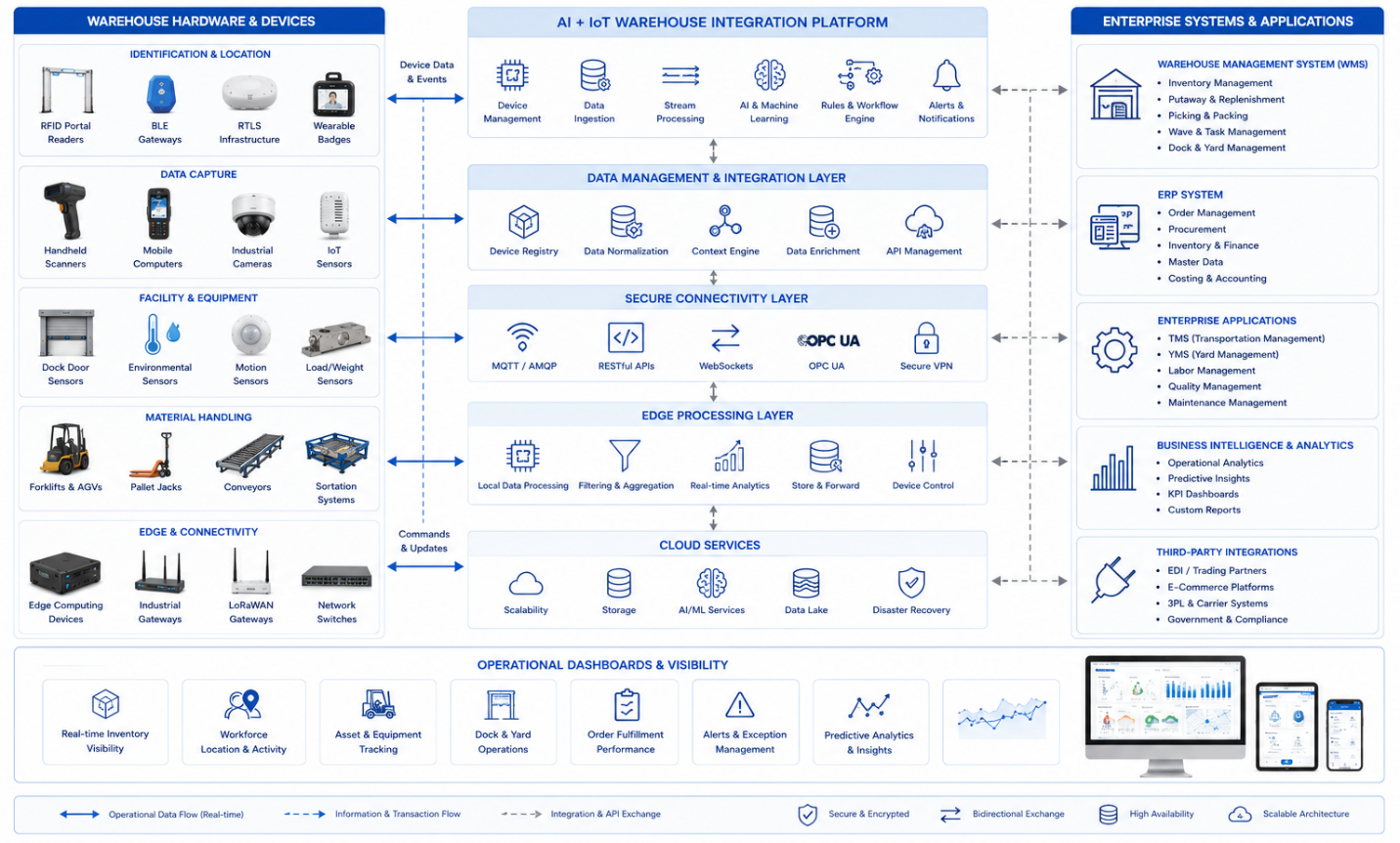
A professional workflow diagram illustrating how an AI and IoT warehouse integration solution connects Warehouse Management Systems (WMS), ERP software, RFID readers, BLE gateways, RTLS infrastructure, handheld scanners, industrial devices, dock door devices, forklifts, edge computing devices, warehouse automation equipment, cloud services, and operational dashboards. The diagram highlights secure bidirectional data exchange between warehouse hardware and enterprise software, enabling real-time visibility, inventory system, asset tracking, workforce monitoring, predictive analytics, and streamlined warehouse operations.
Warehouse Edge Middleware
Warehouse operations require reliable communication between hundreds or thousands of connected devices operating simultaneously throughout distribution facilities. Edge middleware acts as the operational communication layer responsible for coordinating connected devices, validating operational events, and securely exchanging information between warehouse hardware and enterprise software.
WareDist AI warehouse edge middleware supports AI and IoT deployments involving RFID infrastructure, BLE positioning, RTLS technologies, industrial devices, dock equipment, barcode scanners, wearable devices, conveyor systems, and warehouse automation equipment.
Rather than replacing existing Warehouse Management Systems, edge middleware extends their capabilities by providing standardized communication between industrial hardware and business applications.
Multi-Device Orchestration Layer
Warehouse facilities frequently deploy hardware from multiple manufacturers using different communication methods, protocols, and operational interfaces. The Multi-Device Orchestration Layer coordinates these heterogeneous devices and enables them to operate together within a unified warehouse environment.
Supported device categories include
- RFID readers
- RFID antennas
- BLE gateways
- BLE beacons
- RTLS devices
- Barcode scanners
- Industrial devices
- Dock door devices
- Motion devices
- Weight devices
- Wearable devices
- Forklift telematics
- Edge computing hardware
The orchestration layer manages device registration, operational status, event processing, communication monitoring, and hardware synchronization while reducing integration complexity across warehouse operations.
WMS Interoperability Middleware
Warehouse Management Systems remain the operational core of most warehouse facilities. WareDist AI integration solutions enable warehouse hardware and AI and IoT technologies to exchange operational information with existing WMS software without disrupting established warehouse workflows.
Typical integration functions include
- Receiving confirmations
- Inventory movement updates
- Put-away verification
- Replenishment notifications
- Picking confirmations
- Shipping validation
- Inventory adjustments
- Pallet identification
- Asset status synchronization
- Workforce activity records
Real-time interoperability helps eliminate duplicate data entry while improving consistency between warehouse operations and inventory records.
Device Data Normalization Layer
Warehouse environments generate operational information from many different device types. RFID reads, BLE positioning updates, motion detection events, environmental measurements, load device readings, dock status signals, and equipment telemetry often use different formats depending on the hardware manufacturer.
The Device Data Normalization Layer standardizes incoming operational information before forwarding validated data to warehouse software, enterprise applications, reporting systems, and AI analytics.
Key functions include
- Device data validation
- Timestamp synchronization
- Event normalization
- Duplicate event filtering
- Device health monitoring
- Communication verification
- Operational event correlation
- Data quality management
- Standardized event formatting
- Historical event recording
Standardized operational information improves reporting accuracy while simplifying integration with Warehouse Management Systems, ERP software, and business system solutions.
Benefits of Warehouse Edge Integration
Warehouse edge middleware provides significant operational advantages by connecting warehouse hardware with enterprise software while maintaining dependable communication throughout daily operations.
Key benefits include
- Automated communication between warehouse hardware and business systems
- Reduced manual operational data entry
- Consistent information across warehouse software
- Faster inventory updates
- Improved warehouse workforce visibility
- Better equipment monitoring
- Improved asset tracking
- More accurate operational reporting
- Simplified device management
- Scalable support for future warehouse expansion
Edge integration enables warehouse organizations to improve operational coordination while supporting AI-assisted warehouse management across multiple facilities and operational workflows.
Deployment Solutions
Warehouse and distribution facilities operate with different IT strategies depending on operational requirements, security policies, business continuity objectives, and infrastructure investments. Some organizations prefer cloud-based deployments for centralized management, while others require local servers to support low-latency warehouse operations or strict data governance. Many facilities adopt hybrid approaches that combine local processing with centralized enterprise reporting.
WareDist AI supports flexible deployment models that integrate AI and IoT technologies with Warehouse Management Systems, ERP software, RFID infrastructure, BLE positioning systems, industrial devices, and edge computing devices. Each deployment option is designed to maintain secure communication, reliable operational performance, and scalability across warehouse and fulfillment operations.
Cloud Version Deployment
Cloud deployment enables warehouse facilities to centralize operational data while providing authorized users with secure access to warehouse information from multiple locations. Operational events collected from RFID readers, BLE gateways, industrial devices, handheld scanners, dock equipment, and edge devices are transmitted securely to cloud-hosted warehouse software for processing and reporting.
Cloud deployments support organizations operating multiple warehouses, regional distribution centers, or geographically dispersed logistics facilities by enabling centralized visibility across inventory, workforce activities, and material handling equipment.
Typical capabilities include
- Centralized warehouse monitoring
- Multi-site inventory visibility
- Secure remote system access
- Centralized device administration
- Enterprise reporting
- AI-assisted operational analytics
- Automated software updates
- Disaster recovery support
- Business continuity planning
- Scalable computing resources
Cloud deployment simplifies enterprise-wide warehouse management while supporting long-term operational growth.
Server Version Deployment
Many warehouse operators require locally hosted systems to meet internal security requirements, operational latency expectations, or regulatory obligations. Server deployments maintain warehouse software, operational databases, and integration services within the organization’s own infrastructure while supporting continuous communication with connected warehouse hardware.
Locally hosted deployments are particularly appropriate for facilities that require uninterrupted operations even during external network interruptions.
Typical deployment characteristics include
- Local operational processing
- On-premises data storage
- Low-latency communications
- Internal security management
- Local backup procedures
- Direct integration with existing infrastructure
- Controlled software administration
- High operational availability
- Internal network optimization
- Warehouse-specific performance tuning
Server deployments provide organizations with greater control over operational infrastructure while maintaining dependable warehouse performance.
Hybrid Edge Deployment
Hybrid edge deployment combines local operational processing with centralized enterprise synchronization. Warehouse hardware communicates with edge computing devices that process operational events close to the source before transmitting validated information to centralized warehouse software and enterprise applications.
This deployment model is particularly valuable for high-volume warehouse operations where rapid local decision making is required while maintaining centralized reporting across multiple facilities.
Edge processing supports
- Local RFID event processing
- BLE location calculations
- Device data filtering
- Operational event validation
- Temporary data storage
- Network traffic optimization
- Device coordination
- Local alarm generation
- Secure enterprise synchronization
- Continuous warehouse operation
Hybrid deployments improve responsiveness while reducing network bandwidth requirements and supporting resilient warehouse operations.
WMS & ERP Connectivity
Warehouse operations depend on continuous information exchange between Warehouse Management Systems, Enterprise Resource Planning software, inventory systems, transportation applications, procurement systems, and connected warehouse devices. WareDist AI integration solutions enable these systems to exchange operational information securely while reducing manual processing and improving data consistency.
The integration approach preserves existing warehouse workflows while extending operational visibility through AI and IoT technologies.
WMS Real-Time Synchronization
Warehouse Management Systems coordinate receiving, put-away, inventory control, replenishment, picking, packing, and shipping activities. Real-time synchronization ensures that operational events generated by connected warehouse devices are reflected immediately within WMS software.
Examples of synchronized warehouse events include
- Receiving confirmations
- Inventory location updates
- Pallet movement records
- Picking confirmations
- Packing completion
- Shipping verification
- Inventory adjustments
- Cycle counting updates
- Workforce activity records
- Equipment utilization information
Continuous synchronization improves inventory accuracy while reducing discrepancies between warehouse operations and system records.
ERP Data Streaming Layer
Enterprise Resource Planning systems depend on accurate warehouse information to support purchasing, production planning, financial reporting, customer fulfillment, transportation coordination, and inventory valuation. The ERP Data Streaming Layer securely exchanges operational information between warehouse systems and enterprise business applications.
Operational information shared with ERP systems may include
- Inventory availability
- Goods receipt confirmation
- Shipment completion
- Material consumption
- Warehouse transfers
- Asset utilization
- Equipment status
- Operational exceptions
- Order fulfillment progress
- Warehouse performance metrics
Reliable ERP connectivity helps ensure that enterprise planning reflects current warehouse conditions.
Edge-to-Cloud Data Pipeline
Warehouse operations continuously generate information from RFID infrastructure, BLE positioning systems, industrial devices, dock equipment, wearable devices, barcode scanners, and edge computing hardware. The Edge-to-Cloud Data Pipeline securely transfers validated operational events from local warehouse infrastructure to centralized enterprise software and reporting systems.
Pipeline functions include
- Secure event transmission
- Data validation
- Event prioritization
- Buffered communications
- Data compression
- Communication monitoring
- Operational logging
- Historical data synchronization
- Enterprise reporting support
- Long-term data retention
The pipeline enables organizations to maintain reliable operational visibility across multiple warehouse locations while minimizing communication delays and preserving data integrity.
Integration Benefits Across Warehouse Operations
Connecting warehouse hardware, enterprise software, and operational workflows creates a consistent information environment that supports accurate decision making throughout the distribution process.
Organizations implementing integrated AI and IoT warehouse solutions can benefit from:
- Real-time inventory synchronization
- Improved warehouse workforce visibility
- Faster asset identification and tracking
- Automated operational data exchange
- Reduced manual data entry
- Improved shipment verification
- Better warehouse reporting
- Increased operational transparency
- Enhanced inventory traceability
- Scalable integration supporting warehouse growth
Integrated warehouse systems enable organizations to coordinate inventory, personnel, equipment, and enterprise business processes while supporting higher operational efficiency and more reliable warehouse performance.
Business Benefits of Warehouse System Integration
Effective warehouse integration allows organizations to connect operational technologies, enterprise software, and warehouse hardware into a coordinated information environment. Rather than maintaining isolated systems that require duplicate data entry and manual reconciliation, integrated AI and IoT solutions provide accurate operational information throughout receiving, storage, replenishment, picking, packing, shipping, and yard management.
WareDist AI integration solutions help warehouse and distribution organizations improve workforce visibility, inventory accuracy, asset utilization, and operational coordination while preserving existing Warehouse Management System investments.
Organizations implementing integrated warehouse solutions can achieve measurable operational benefits, including:
- Real-time communication between warehouse hardware and enterprise software
- Improved inventory accuracy through automated synchronization
- Continuous visibility into warehouse personnel, assets, and inventory
- Faster receiving, put-away, replenishment, and fulfillment operations
- Reduced manual data entry and duplicate transaction processing
- Improved warehouse access management and operational security
- Better coordination between warehouse operations and transportation activities
- Enhanced warehouse traceability and operational audit readiness
- Simplified integration of RFID, BLE, RTLS, industrial devices, and edge devices
- Scalable infrastructure supporting warehouse expansion and additional facilities
These benefits help organizations improve operational consistency while supporting long-term warehouse modernization initiatives.
Integration Applications for Warehouse & Distribution Facilities
Warehouse integration solutions are designed to support diverse operational environments across the industrial logistics and supply chain sector. Each deployment is configured according to warehouse layout, inventory characteristics, operational workflows, regulatory requirements, and enterprise system architecture.
Typical deployment environments include
- Regional distribution centers
- E-commerce fulfillment centers
- Third-party logistics facilities
- Manufacturing warehouses
- Spare parts distribution centers
- Cold storage warehouses
- Cross-docking facilities
- High-density rack storage operations
- Automated sortation centers
- Bulk material distribution facilities
- Returnable container management operations
- Industrial packaging and palletization facilities
Within these environments, integrated AI and IoT technologies support warehouse personnel visibility, controlled access management, pallet tracking, inventory monitoring, dock operations, trailer coordination, work-in-progress monitoring where applicable, and end-to-end traceability.
The ability to integrate warehouse hardware with enterprise software enables organizations to respond more quickly to operational changes while maintaining accurate inventory records and dependable warehouse performance.
Built on Proven Industrial IoT Experience
WareDist AI is developed within Aperture Venture Studio with support from GAO and is built upon more than two decades of industrial IoT experience. The engineering approach reflects practical knowledge gained from supporting thousands of IoT deployments involving warehousing, distribution, logistics, manufacturing, transportation, and industrial automation.
Our integration solutions are designed using proven implementation methodologies supported by experienced engineers specializing in RFID, BLE, RTLS, industrial networking, edge computing, warehouse software integration, enterprise connectivity, and AI-assisted operational analysis.
Continuous investment in research and development, comprehensive quality assurance processes, and experienced remote and onsite technical support enables WareDist AI to recommend integration strategies that align with warehouse operational requirements while protecting existing infrastructure investments.
Technical leadership includes Ph.D. professionals from leading universities working alongside specialists in industrial wireless communications, embedded systems, AI applications, warehouse automation, and enterprise software integration. This experience has supported Fortune 500 companies, leading research organizations, prestigious universities, and government agencies throughout the United States and Canada.
The resulting expertise helps organizations integrate warehouse technologies with confidence while maintaining operational continuity, data integrity, and long-term scalability.
Connect Your Warehouse Operations with AI and IoT Integration
Successful warehouse modernization depends on reliable communication between operational technologies, warehouse software, and enterprise business systems. WareDist AI provides integration solutions that connect RFID infrastructure, BLE positioning systems, industrial devices, edge computing devices, Warehouse Management Systems, ERP software, and warehouse automation equipment into a coordinated operational environment.
Whether the objective is improving warehouse workforce visibility, strengthening access control, expanding asset tracking, increasing inventory accuracy, enhancing traceability, or supporting future warehouse automation, our engineering specialists work closely with organizations to design integration solutions that align with operational goals and existing infrastructure.
Our integration approach preserves current warehouse investments while enabling organizations to adopt AI and IoT technologies that improve operational visibility, warehouse productivity, inventory management, and enterprise reporting.
Contact WareDist AI to discuss your warehouse integration requirements and learn how connected warehouse systems can help improve operational efficiency across your warehouse and fulfillment operations.
Contact WareDist AI