
AI Systems Across Every Warehouse Operation
Discover AI-driven warehouse analytics for workforce, inventory, dock operations, fulfillment, compliance, forklifts, and warehouse performance optimization.
AI Analytics for Smarter Warehouse Decision Making
Warehouse and distribution facilities generate massive volumes of operational data every minute. Pallets move between receiving docks and storage racks, forklifts transport inventory across warehouse zones, pickers fulfill customer orders, trailers arrive and depart from loading docks, and inventory continuously flows through replenishment, packing, staging, and shipping operations. Transforming this operational data into actionable business decisions requires more than connected devices. It requires AI and IoT systems capable of continuously analyzing warehouse activities and identifying opportunities for operational improvement.
WareDist AI provides AI-powered warehouse analytics specifically designed for industrial warehousing and distribution operations. By combining AI with RFID, BLE, RTLS, industrial IoT devices, edge computing, and warehouse software, organizations gain real-time operational visibility that supports faster decisions, higher inventory accuracy, improved workforce productivity, optimized material handling, and better fulfillment performance.
Unlike traditional reporting systems that summarize historical information, AI continuously evaluates live operational data to identify trends, detect anomalies, forecast operational risks, and recommend corrective actions before disruptions affect warehouse performance. These AI functions operate across receiving, put-away, storage, replenishment, order picking, packing, shipping, returns processing, and yard operations while integrating with Warehouse Management Systems (WMS), Enterprise Resource Planning (ERP) software, RFID infrastructure, and warehouse automation equipment.
AI Analytics Designed for Warehouse & Distribution Operations
Warehouse operations involve thousands of simultaneous activities distributed across multiple operational zones. Managing personnel, inventory, material handling equipment, loading docks, warehouse assets, and customer orders requires continuous awareness of changing operational conditions.
WareDist AI applies AI and IoT technologies to monitor these activities in real time while converting operational data into meaningful warehouse performance indicators. AI models evaluate warehouse workflows, compare live operational performance with historical trends, and identify process variations that influence productivity, safety, inventory accuracy, and customer service.
Rather than replacing warehouse personnel, AI supports supervisors, warehouse managers, logistics planners, and operations teams by providing data-driven recommendations based on continuously updated warehouse information.
Core AI capabilities support
- Workforce productivity improvement
- Warehouse access monitoring
- Material handling optimization
- Inventory visibility
- Order fulfillment performance
- Warehouse asset utilization
- Operational compliance
- Warehouse process optimization
- Predictive operational planning
- Continuous warehouse performance analysis
These capabilities enable warehouse operators to make informed operational decisions supported by measurable data rather than manual observations alone.
AI-Powered Warehouse Operational Analytics Workflow
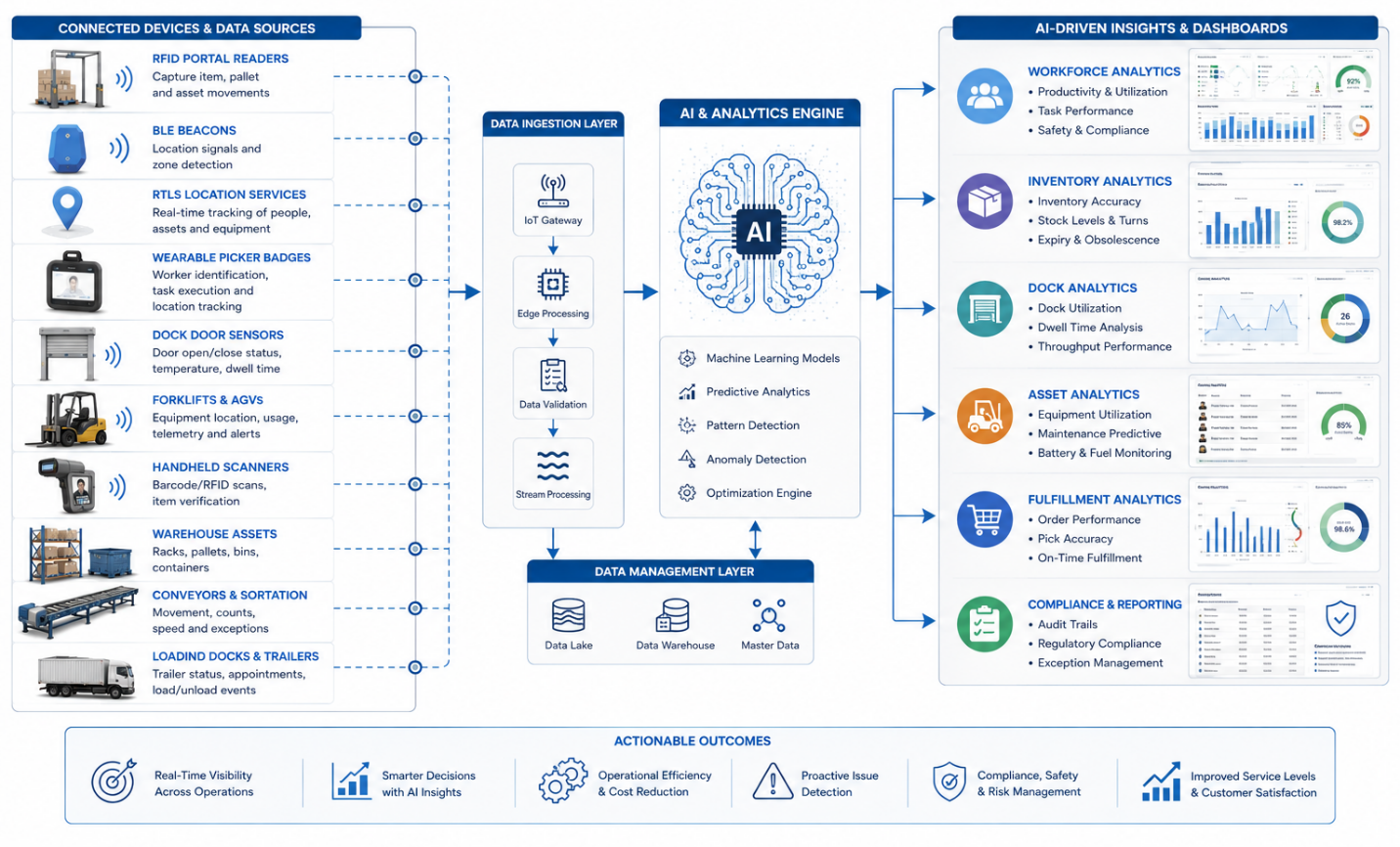
A professional workflow diagram illustrating how operational data from RFID portal readers, BLE beacons, RTLS location services, wearable picker badges, dock door devices, forklifts, handheld scanners, warehouse racks, pallets, conveyors, and loading docks is collected and processed by AI. The AI engine generates workforce analytics, inventory analytics, dock analytics, asset analytics, fulfillment analytics, and compliance reporting through interactive dashboards, enabling real-time operational visibility and data-driven warehouse decision-making.
Applications of AI Analytics in Warehouse & Distribution Facilities
AI analytics supports nearly every operational activity performed within modern warehouse and distribution facilities. Distribution centers handling consumer products, industrial components, manufacturing inventory, spare parts, pharmaceuticals, retail merchandise, and e-commerce orders all benefit from continuous operational monitoring and predictive analysis.
Typical warehouse applications include
- Distribution centers
- Regional fulfillment centers
- E-commerce warehouses
- Third-party logistics facilities
- Manufacturing warehouses
- Cross-dock terminals
- Spare parts distribution centers
- High-density storage facilities
- Cold storage warehouses
- Automated sortation facilities
AI continuously evaluates warehouse activity across these environments to improve operational efficiency, reduce unnecessary travel, optimize storage utilization, and strengthen inventory accuracy.
Warehouse Workforce Analytics
Warehouse personnel remain one of the most dynamic resources within distribution operations. Productivity depends on efficient movement between picking locations, coordinated labor assignments, safe equipment operation, and balanced workloads across receiving, replenishment, picking, packing, and shipping activities.
WareDist AI combines AI with BLE location services, RTLS technologies, RFID identification, wearable devices, and operational analytics to provide continuous workforce visibility throughout warehouse facilities. Rather than simply recording employee attendance, AI evaluates movement patterns, operational workflows, task completion times, travel distances, congestion points, and labor utilization to identify opportunities for operational improvement.
Warehouse supervisors can understand how personnel move through warehouse aisles, how work is distributed between operational zones, and where operational delays occur during each shift. AI models compare workforce performance across multiple shifts while identifying trends that support workforce planning, productivity improvement, and safer warehouse operations.
Real-Time Picker Locationing
BLE beacons, RTLS technologies, wearable badges, and location-aware devices continuously determine picker locations throughout warehouse facilities. AI evaluates movement patterns to optimize travel paths, reduce unnecessary walking distances, improve zone assignments, and balance picking activities across multiple warehouse areas.
Labor Utilization Benchmarking
AI compares workforce performance using operational metrics such as completed picks, travel distance, task completion rates, idle time, replenishment support, and shift productivity. Warehouse managers gain objective performance measurements that support workforce planning and continuous operational improvement.
Forklift Operator Risk Scoring
AI analyzes forklift movement, operating speed, braking behavior, route selection, interaction with pedestrians, congestion events, and operational history to identify conditions that may increase safety risks. These insights support proactive safety management while helping reduce operational incidents.
Aisle Congestion Detection
AI continuously monitors warehouse traffic generated by forklifts, pallet jacks, autonomous equipment, and warehouse personnel. Congestion patterns are detected automatically, allowing supervisors to redistribute work assignments, adjust travel routes, or modify picking strategies before delays affect fulfillment operations.
Warehouse Workforce Analytics helps organizations improve labor productivity while supporting safer warehouse operations, more efficient travel paths, balanced workloads, and higher operational visibility.
Dock & Zone Access Analytics
Loading docks serve as critical transition points where inventory enters and leaves warehouse facilities. Efficient dock scheduling, secure access management, trailer coordination, and controlled movement between warehouse zones are essential for maintaining operational throughput and protecting inventory.
WareDist AI combines AI, RFID, BLE credentials, industrial devices, dock door monitoring, access control systems, and warehouse software to continuously evaluate dock operations and facility access activities. AI identifies operational bottlenecks, predicts dock utilization, validates authorized personnel movement, and provides complete visibility into receiving and shipping operations.
Modern warehouse facilities often manage dozens or hundreds of dock doors operating simultaneously. AI assists warehouse managers by continuously analyzing loading activities, trailer arrivals, unloading performance, workforce assignments, and yard-to-dock coordination to improve operational efficiency.
Material Handling Asset Analytics
Material handling equipment (MHE) forms the operational backbone of warehouse and distribution facilities. Forklifts, reach trucks, pallet jacks, order pickers, tow tractors, automated guided vehicles (AGVs), dock levelers, and conveyor systems move inventory continuously between receiving, storage, replenishment, picking, packing, and shipping areas. Limited visibility into equipment location, utilization, maintenance status, and operational performance can reduce productivity and increase operating costs.
WareDist AI combines AI and IoT technologies with RFID, BLE, RTLS, industrial devices, and edge software to continuously monitor material handling assets across warehouse facilities. AI evaluates operating hours, travel routes, idle time, battery health, equipment availability, maintenance records, and utilization patterns to provide warehouse managers with a comprehensive understanding of equipment performance.
Operational data collected from connected equipment helps identify inefficient travel routes, excessive idle time, recurring maintenance issues, and equipment shortages during peak warehouse activities. AI also compares equipment usage across shifts and warehouse zones, supporting more effective fleet allocation and long-term capital planning.
These capabilities improve operational efficiency while extending equipment service life and reducing unexpected downtime.
Forklift & Pallet Jack Utilization
Forklifts and pallet jacks represent some of the most heavily used assets within warehouse operations. AI continuously evaluates equipment movement, utilization rates, travel distances, operating hours, idle periods, and assignment history to determine whether equipment resources are being used efficiently.
Warehouse supervisors can identify
- Underutilized forklifts
- Equipment shortages during peak shifts
- Excessive travel distances
- Idle equipment across warehouse zones
- Equipment sharing opportunities
- Fleet balancing recommendations
Improved utilization reduces unnecessary equipment purchases while increasing warehouse productivity.
Returnable Container Recovery Analytics
Returnable pallets, totes, bins, containers, cages, and transport racks frequently circulate between warehouses, distribution centers, suppliers, and customers. Losing visibility of these assets increases replacement costs and disrupts warehouse operations.
RFID identification, BLE tags, and AI-assisted asset monitoring continuously record container movements throughout receiving, storage, outbound shipping, returns processing, and redistribution activities.
AI identifies
- Missing containers
- Delayed asset returns
- High-loss operational zones
- Asset circulation trends
- Container utilization rates
- Recovery opportunities
These insights improve asset accountability while reducing replacement expenses.
MHE Predictive Maintenance
Unexpected equipment failures frequently interrupt warehouse productivity. AI analyzes vibration data, operating temperatures, battery health, hydraulic performance, motor utilization, maintenance history, and operating hours collected from connected IoT devices.
Machine learning models estimate maintenance requirements before mechanical failures occur, allowing warehouse maintenance teams to schedule servicing during planned maintenance windows rather than reacting to unexpected breakdowns.
Predictive maintenance supports
- Reduced unplanned downtime
- Longer equipment lifespan
- Improved maintenance scheduling
- Lower repair costs
- Higher equipment availability
- Better warehouse throughput
Dock Equipment Downtime Forecasting
Loading dock equipment such as dock levelers, vehicle restraints, overhead doors, dock shelters, and conveyor systems directly influence receiving and shipping efficiency.
AI continuously evaluates operational history, device readings, usage frequency, environmental conditions, and maintenance records to estimate equipment reliability and identify components approaching service intervals.
Warehouse managers receive operational insights that help maintain uninterrupted dock operations while minimizing shipment delays.
Inventory & Stock Analytics
Inventory accuracy directly affects warehouse productivity, customer satisfaction, replenishment efficiency, and order fulfillment performance. Large distribution facilities often manage hundreds of thousands of SKUs distributed across pallet racks, shelving systems, reserve storage, picking locations, and staging areas.
WareDist AI applies AI and IoT technologies to continuously monitor inventory movement using RFID, BLE asset identification, handheld scanners, fixed RFID readers, industrial devices, and Warehouse Management System integration. AI transforms inventory events into actionable operational insights that support inventory planning and warehouse optimization.
Rather than relying exclusively on scheduled inventory counts, AI continuously evaluates inventory movement, stock availability, replenishment activities, storage utilization, and picking behavior throughout warehouse operations.
SKU-Level Stock Visibility
RFID readers, barcode scanners, BLE devices, and Warehouse Management System integration provide continuous visibility into individual SKU locations.
Warehouse personnel gain immediate access to
- Current inventory location
- Storage zone assignment
- Pallet identification
- Bin location
- Inventory movement history
- Stock availability
Continuous visibility reduces search time and improves order fulfillment accuracy.
Replenishment Demand Forecasting
AI analyzes historical demand, seasonal order patterns, warehouse throughput, inventory turnover, and replenishment cycles to forecast future inventory requirements.
Warehouse planners can anticipate
- Fast-moving inventory
- Low-stock conditions
- Reserve inventory requirements
- Picking location replenishment
- Seasonal inventory changes
- Safety stock recommendations
These forecasts support efficient inventory planning while minimizing stock shortages.
Slotting Optimization Analytics
Warehouse slotting significantly affects picker productivity and travel efficiency.
AI evaluates
- SKU velocity
- Picking frequency
- Product dimensions
- Storage accessibility
- Order history
- Warehouse travel paths
Based on operational analysis, AI recommends improved storage assignments that reduce picker travel distances while increasing warehouse throughput.
Cycle Count Variance Detection
Inventory discrepancies frequently result from receiving errors, misplaced inventory, incorrect picking, shipping mistakes, or manual data entry.
AI continuously compares inventory movement records with physical inventory observations collected through RFID and warehouse scanning technologies.
Variance analysis identifies
- Inventory mismatches
- Location inconsistencies
- Missing inventory
- Duplicate records
- Unverified movements
- Exception patterns
Warehouse managers can investigate discrepancies earlier rather than waiting for scheduled physical inventory counts.
Order Fulfillment Analytics
Order fulfillment performance determines customer satisfaction, warehouse productivity, transportation scheduling, and overall supply chain efficiency. Every fulfillment activity generates operational data that AI evaluates to improve warehouse execution.
WareDist AI continuously analyzes warehouse workflows from order release through picking, packing, staging, loading, and shipment confirmation. AI identifies workflow bottlenecks, predicts operational delays, and recommends workload adjustments based on current warehouse activity.
Real-time operational monitoring enables warehouse supervisors to make informed decisions before fulfillment issues affect customer commitments.
Pick-Pack Cycle Benchmarking
AI compares the performance of picking and packing activities across warehouse zones, shifts, product categories, and order types.
Operational measurements include
- Average picking time
- Packing duration
- Travel distance
- Order completion time
- Labor productivity
- Picking accuracy
These benchmarks support continuous warehouse process improvement.
Wave Planning Optimization
Warehouse wave planning determines how customer orders are grouped for efficient processing.
AI evaluates
- Order priority
- SKU availability
- Picker workload
- Equipment availability
- Warehouse congestion
- Shipping schedules
Recommendations improve workload balancing while increasing fulfillment throughput.
Order Throughput Forecasting
AI continuously estimates warehouse processing capacity based on live operational conditions.
Forecasting considers
- Current order volume
- Workforce availability
- Inventory readiness
- Equipment utilization
- Dock availability
- Historical processing performance
Warehouse managers receive realistic throughput estimates that improve scheduling and customer communication.
Lot & Compliance Analytics
Warehousing and distribution operations require complete visibility into product movement, inventory ownership, lot history, and regulatory documentation. Industries such as pharmaceuticals, food and beverage, chemicals, medical devices, electronics, and industrial manufacturing often require accurate records demonstrating where products have been stored, how they moved through the warehouse, and who handled them during each operational stage.
WareDist AI applies AI and IoT technologies to continuously monitor lot-controlled inventory, shipment movements, warehouse transactions, and operational events. By combining RFID identification, BLE location services, handheld scanners, warehouse devices, and AI analytics, organizations can maintain accurate operational records while reducing manual documentation efforts.
Rather than relying solely on manual record keeping, AI continuously validates warehouse events, identifies inconsistencies, and assists warehouse personnel in maintaining complete operational histories throughout receiving, storage, picking, packing, staging, shipping, and returns processing.
Lot Traceability Analytics
Products managed by lot, batch, serial number, or production date require continuous tracking throughout warehouse operations. AI evaluates inventory movement data collected from RFID readers, barcode scanners, handheld terminals, BLE devices, and Warehouse Management Systems to create a comprehensive history for every tracked inventory unit.
Lot traceability capabilities include
- Lot movement monitoring
- Batch inventory visibility
- Product genealogy recording
- Storage location history
- Receiving verification
- Shipment validation
- Recall readiness support
- Expiration monitoring
- Inventory aging analysis
- Warehouse transfer verification
Complete lot visibility allows warehouse operators to locate affected inventory rapidly during product recalls, quality investigations, or customer inquiries.
Chain-of-Custody Verification
Many warehouse operations require documented evidence showing how inventory moved between receiving, storage, picking, packing, transportation, and customer shipment. AI assists by validating each operational event against predefined warehouse procedures and automatically identifying missing or inconsistent records.
Warehouse organizations benefit from
- Verified inventory transfers
- Personnel interaction records
- Timestamp validation
- Dock movement verification
- Shipment confirmation
- Secure inventory handoffs
- Warehouse process validation
- Operational accountability
Chain-of-custody verification strengthens operational transparency while supporting customer confidence and regulatory compliance.
Compliance Audit Trail Insights
Warehouse facilities routinely generate thousands of operational events each day. AI transforms these events into searchable audit records that simplify operational reviews and compliance reporting.
Operational audit capabilities include
- Warehouse event history
- Access activity logs
- Inventory transaction records
- Equipment operation history
- Workforce activity reporting
- Shipping verification records
- Receiving documentation
- Exception analysis
- Compliance reporting
- Historical operational analytics
These records support internal audits, customer documentation requests, quality management activities, and regulatory inspections.
Business Benefits of AI Warehouse Analytics
Warehouse AI analytics converts operational data into measurable business improvements that support productivity, inventory accuracy, operational efficiency, and informed decision making. Instead of reviewing historical reports after operational issues occur, warehouse managers receive continuous operational visibility that helps them respond proactively.
Organizations implementing AI and IoT warehouse analytics can improve multiple operational areas, including:
- Higher workforce productivity through optimized labor allocation
- Improved warehouse safety by identifying operational risks
- Greater inventory accuracy with continuous inventory monitoring
- Better forklift and material handling equipment utilization
- Reduced equipment downtime through predictive maintenance
- Faster receiving and shipping operations
- Improved dock scheduling and trailer coordination
- More efficient order fulfillment and wave planning
- Reduced inventory search time
- Better storage space utilization
- Improved compliance reporting and operational documentation
- Enhanced decision making supported by real-time operational data
These benefits contribute to more reliable warehouse operations while supporting customer service goals and long-term operational improvement.
Built on Proven Industrial IoT Experience
WareDist AI combines practical warehouse knowledge with decades of IoT implementation experience. Developed within Aperture Venture Studio with support from GAO, the company draws upon more than twenty years of industrial IoT expertise gained through thousands of customer deployments and successful projects across warehousing, logistics, manufacturing, and industrial operations.
Significant investments in research and development, structured quality assurance processes, and experienced engineering teams ensure dependable AI and IoT solutions that integrate with existing warehouse technologies. Technical leadership from Ph.D. professionals, combined with specialists in RFID, BLE, RTLS, industrial networking, embedded systems, AI software, and warehouse operations, provides organizations with practical guidance throughout planning, deployment, and ongoing support.
This experience has supported projects for Fortune 500 companies, leading research organizations, respected universities, and government agencies across the United States and Canada, providing a strong foundation for warehouse AI analytics solutions.
Transform Warehouse Operations with AI-Driven Analytics
Warehouse performance depends on accurate information, timely operational decisions, and continuous visibility across workforce activities, inventory movement, material handling equipment, dock operations, and fulfillment workflows. AI and IoT technologies help warehouse organizations analyze these operations continuously while identifying opportunities for measurable improvement.
WareDist AI provides AI analytics that integrate with existing Warehouse Management Systems, RFID infrastructure, BLE devices, RTLS technologies, industrial devices, and enterprise software, enabling warehouse operators to strengthen operational visibility without disrupting established workflows.
Whether the objective is improving picker productivity, increasing inventory accuracy, optimizing forklift utilization, strengthening dock operations, supporting regulatory compliance, or enhancing fulfillment performance, AI analytics provides the operational insights needed to support efficient, data-driven warehouse management.
Contact our specialists to explore how AI and IoT warehouse analytics can help your organization improve visibility, productivity, compliance, and operational performance across every stage of warehouse and distribution operations.
Contact Our Specialists