
Resources for Smarter Warehouse Transformation
Access warehouse implementation guides, WMS integration documentation, deployment resources, FAQs, and warehouse case studies.
Warehouse AIoT Learning & Resource Center
Successful AI and IoT implementation in warehouse and distribution operations requires more than deploying RFID readers, BLE beacons, industrial devices, and warehouse software. Organizations also need practical implementation guidance, technical documentation, deployment methodologies, integration references, and operational best practices to ensure successful long-term adoption.
The WareDist AI Knowledge Center serves as a technical resource for warehouse operators, logistics managers, warehouse engineers, system integrators, IT professionals, operations leaders, and digital transformation teams seeking practical guidance on implementing AI and IoT technologies throughout warehouse and fulfillment operations.
The resources available within this knowledge center are designed to help organizations understand warehouse modernization strategies, workforce visibility systems, access management, inventory tracking, asset monitoring, warehouse integration, operational analytics, and warehouse optimization using enterprise-grade AI and IoT technologies.
Whether planning a new warehouse deployment or expanding existing warehouse capabilities, organizations can use these educational resources to make informed implementation decisions while reducing project risk.
Applications Covered by the Knowledge Center
The documentation and technical resources focus on practical warehouse deployment scenarios across numerous operational environments.
Common warehouse applications include
- Distribution center operations
- E-commerce fulfillment
- Cold storage facilities
- Cross-docking operations
- Third-party logistics warehouses
- High-density rack storage
- Automated sortation facilities
- Spare parts distribution
- Industrial packaging operations
- Bulk material warehouses
- Returnable container management
- Multi-site warehouse operations
Each resource explains how AI and IoT technologies can improve workforce visibility, secure access management, inventory accuracy, asset tracking, work-in-progress monitoring where appropriate, and product traceability.
Warehouse AIoT Knowledge Center for Warehousing & Distribution Operations
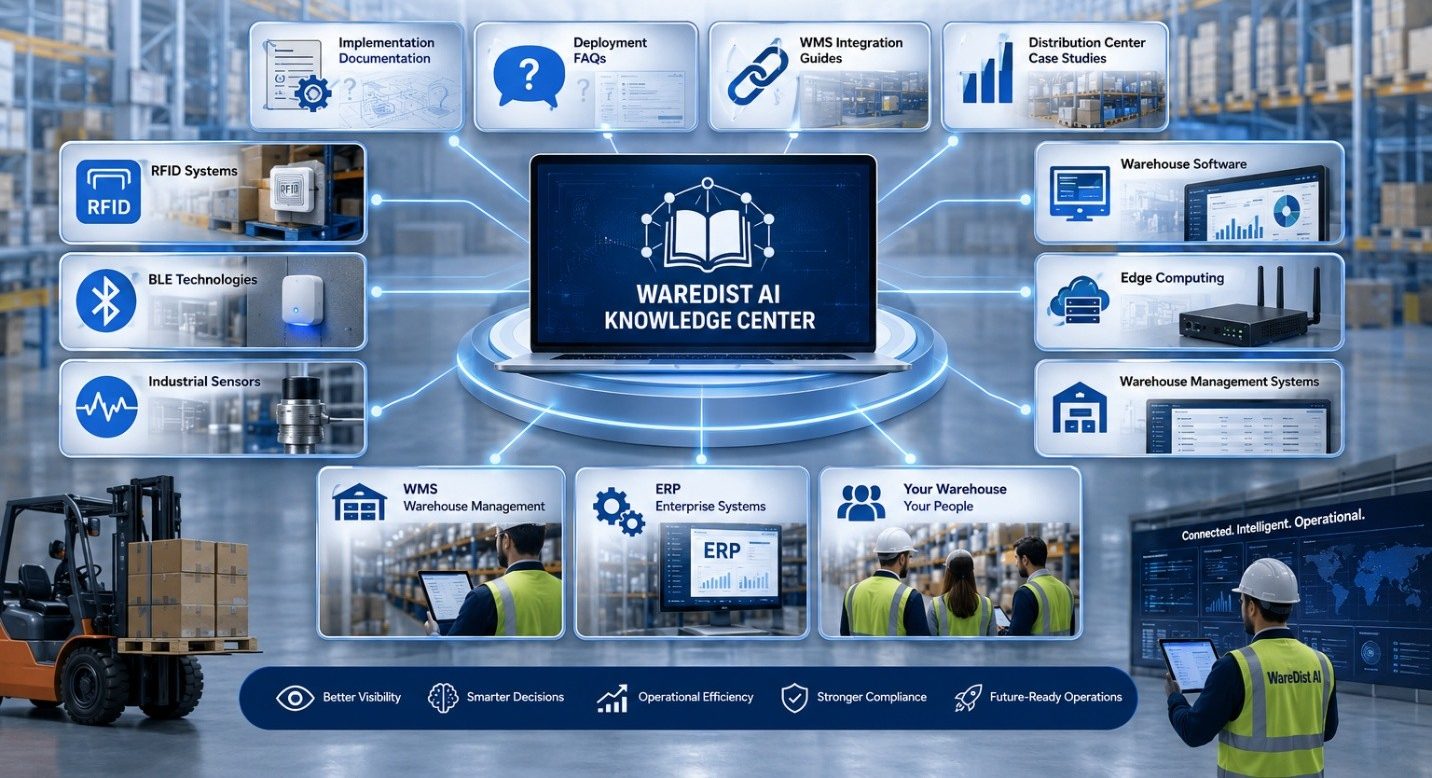
This illustration presents the WareDist AI Knowledge Center as a centralized resource hub for Warehousing & Distribution operations. It connects implementation documentation, deployment FAQs, WMS integration guides, distribution center case studies, RFID systems, BLE technologies, industrial devices, warehouse software, edge computing, ERP systems, and warehouse personnel, demonstrating how AI and IoT knowledge supports successful warehouse deployment, integration, operational excellence, and continuous learning.
Implementation Documentation
Proper implementation planning significantly improves the success of warehouse modernization projects. Implementation documentation provides detailed technical guidance covering planning activities, infrastructure assessment, hardware deployment, software configuration, integration procedures, validation testing, and operational commissioning.
WareDist AI implementation documentation supports organizations throughout every stage of warehouse deployment by providing practical engineering guidance based on extensive industrial IoT implementation experience.
Implementation resources typically include
- Warehouse assessment methodology
- RFID deployment planning
- BLE positioning design
- Warehouse network requirements
- Industrial device installation
- Hardware configuration procedures
- Software installation guidelines
- User role configuration
- Operational testing procedures
- Commissioning checklists
Technical documentation is organized to support warehouse engineers, IT professionals, operations managers, maintenance personnel, and system integration teams responsible for implementing AI and IoT warehouse solutions.
Implementation guides emphasize practical deployment approaches that minimize operational disruption while improving long-term system reliability.
Deployment FAQs
Warehouse modernization projects frequently raise technical, operational, and implementation questions. The Deployment FAQ section provides concise answers to common questions encountered during planning, deployment, system expansion, and ongoing warehouse operations.
Frequently addressed topics include
- RFID reader selection
- BLE beacon placement
- Warehouse wireless coverage
- Inventory tracking accuracy
- Personnel location monitoring
- Access credential management
- Warehouse software integration
- Edge computing deployment
- Warehouse scalability
- Device maintenance
- Operational security
- Data synchronization
Each FAQ focuses on practical operational considerations rather than marketing information, enabling technical teams to understand how AI and IoT technologies perform in real warehouse environments.
The FAQ collection continues to expand as additional warehouse deployment scenarios are documented through ongoing implementation experience.
WMS Integration Guides
Warehouse Management Systems remain central to modern warehouse operations. Successful AI and IoT deployment depends upon reliable communication between warehouse hardware, operational software, and enterprise business systems.
WareDist AI provides detailed WMS integration guides explaining how warehouse technologies communicate with existing Warehouse Management Systems while preserving operational workflows.
Integration guidance covers
- Inventory synchronization
- Receiving workflows
- Put-away verification
- Picking confirmation
- Replenishment automation
- Shipment validation
- RFID event processing
- BLE location services
- Warehouse data synchronization
- ERP communication
- Exception handling
- Operational reporting
The documentation explains recommended integration methodologies, interface considerations, data validation techniques, and operational testing procedures for warehouse environments.
These resources help organizations reduce implementation complexity while maintaining reliable warehouse operations throughout deployment.
Technical Resources for Warehouse Engineers
The Knowledge Center also provides specialized technical resources for engineering teams responsible for planning, implementing, maintaining, and expanding warehouse AI and IoT systems.
Available engineering resources include
- RFID deployment best practices
- BLE positioning optimization
- Industrial wireless communications
- Edge computing configuration
- Warehouse network planning
- Device lifecycle management
- Asset identification standards
- Inventory verification methodologies
- Warehouse cybersecurity considerations
- Operational performance optimization
These materials support engineering teams responsible for maintaining long-term operational reliability across warehouse and fulfillment facilities.
Distribution Center Case Studies
Real-world implementation examples help warehouse operators understand how AI and IoT technologies perform under actual operating conditions. The Distribution Center Case Studies section presents representative deployment scenarios demonstrating how warehouse organizations have improved operational visibility, inventory accuracy, workforce coordination, and fulfillment performance through the adoption of connected technologies.
Each case study focuses on practical implementation considerations while protecting confidential customer information. Rather than emphasizing organizations or brands, the documentation highlights technical approaches, deployment methodologies, operational challenges, and measurable business outcomes.
Topics commonly covered include
- Workforce visibility improvement
- Warehouse access management
- RFID inventory deployment
- BLE-based personnel location systems
- Forklift utilization optimization
- Dock operation monitoring
- Warehouse asset tracking
- Cycle counting automation
- Inventory reconciliation
- Product traceability
- Warehouse software integration
- Multi-site warehouse deployments
These examples help warehouse managers, IT teams, and system integrators evaluate deployment strategies using practical engineering experience rather than theoretical implementation models.
Warehouse AI and IoT Best Practices
Warehouse modernization projects achieve better long-term results when implementation follows structured engineering practices supported by standardized deployment procedures.
The Knowledge Center includes best practice documentation covering every major phase of warehouse AI and IoT implementation.
Recommended planning areas include
- Warehouse operational assessment
- Infrastructure readiness evaluation
- Wireless coverage planning
- RFID read-zone design
- BLE beacon placement strategy
- Device installation verification
- Warehouse software configuration
- User access management
- Integration testing
- Operational acceptance testing
- Staff training
- Ongoing system maintenance
Best practice guidance is developed using practical experience gathered through industrial IoT deployments across warehousing, logistics, manufacturing, transportation, and industrial operations.
These recommendations help organizations reduce implementation risks while improving long-term operational performance.
Built on Proven Industrial IoT Experience
WareDist AI is developed within Aperture Venture Studio with support from GAO and reflects more than two decades of practical industrial IoT deployment experience. The technical knowledge incorporated throughout this Knowledge Center is based upon thousands of successful IoT projects involving warehouse operations, logistics, manufacturing, industrial transportation, and supply chain environments.
Every implementation guide, technical reference, deployment checklist, and integration recommendation reflects practical engineering experience gained through designing, deploying, integrating, and supporting RFID systems, BLE technologies, industrial devices, warehouse software, and enterprise connectivity solutions.
Continuous investment in research and development, comprehensive quality assurance processes, and experienced remote and onsite technical support ensure that the educational resources remain technically accurate and aligned with current warehouse operational practices.
Engineering leadership includes Ph.D. professionals from leading universities together with specialists in industrial wireless communications, embedded systems, warehouse automation, AI-assisted analytics, warehouse software integration, and enterprise networking. This expertise has supported Fortune 500 companies, major research organizations, universities, and government agencies throughout the United States and Canada.
The Knowledge Center extends this experience by providing practical guidance that warehouse organizations can apply throughout planning, deployment, operation, and future system expansion.
Why Use the WareDist AI Knowledge Center?
Warehouse modernization involves multiple technologies, operational processes, enterprise systems, and implementation decisions. The Knowledge Center consolidates technical resources into a structured reference library that supports every stage of an AI and IoT deployment.
Organizations benefit by gaining access to:
- Practical implementation guidance
- Warehouse deployment documentation
- RFID engineering references
- BLE deployment recommendations
- WMS integration documentation
- Warehouse operational best practices
- Technical deployment checklists
- Warehouse case studies
- Frequently asked technical questions
- Long-term maintenance guidance
- Operational optimization recommendations
- Warehouse expansion planning resources
These educational resources help technical teams make informed implementation decisions while improving project consistency across warehouse and distribution operations.
Continue Your Warehouse Modernization Journey
Warehouse technology continues to evolve as AI and IoT solutions become increasingly integrated with inventory management, workforce visibility, warehouse automation, and enterprise software. Organizations that invest in practical technical knowledge are better prepared to implement these technologies efficiently while maintaining operational continuity.
The WareDist AI Knowledge Center is designed to support this journey by providing reliable technical resources for warehouse managers, logistics professionals, IT specialists, warehouse engineers, operations leaders, and system integration teams.
Whether planning an initial RFID deployment, expanding BLE positioning capabilities, integrating Warehouse Management Systems, improving inventory visibility, strengthening access management, or implementing warehouse analytics, the Knowledge Center provides practical guidance to support informed technical decisions.
Contact WareDist AI to learn more about our warehouse AI and IoT solutions, implementation methodologies, engineering resources, and technical consulting services for warehouse and fulfillment operations.
Contact WareDist AI