
AIoT Solutions for Warehouse & Distribution Operations
AI-powered IoT improves warehouse visibility, inventory accuracy, fulfillment efficiency, and facility performance.
Overview
Modern warehouses and distribution centers require accurate inventory, coordinated workforces, dependable material-handling equipment, and real-time visibility across storage, docks, and fulfillment activities. WareDist AI combines AI and IoT technologies such as RFID, BLE, RTLS, industrial devices, edge computing, and connected warehouse systems to improve operational efficiency, inventory accuracy, and compliance.
By connecting data from inventory, employees, equipment, and warehouse assets, WareDist AI helps teams monitor receiving, put-away, replenishment, picking, packing, shipping, returns, and yard operations. AI-powered analytics transform operational data into actionable insights, supporting faster and more informed decisions.
The solution strengthens workforce visibility, facility access, asset tracking, inventory control, fulfillment optimization, and traceability while integrating with existing WMS, ERP Systems, automation equipment, and warehouse communication infrastructure.
AI and IoT Systems Designed for Modern Warehouse Operations
Warehouse and distribution facilities continue to expand in both size and operational complexity. Large fulfillment centers may contain hundreds of dock doors, thousands of storage locations, multiple picking zones, automated sortation systems, cross-docking areas, and fleets of forklifts and pallet jacks operating simultaneously. Maintaining visibility across these environments requires continuous monitoring supported by intelligent technologies.
WareDist AI applies AIoT technologies throughout warehouse operations to improve operational awareness without disrupting existing workflows. RFID portals automatically identify pallets moving through dock doors. BLE beacons assist with real-time picker locationing and equipment positioning. RTLS technologies monitor the movement of people, forklifts, and mobile assets across warehouse zones. Industrial IoT devices collect environmental, motion, and equipment data that AI software analyzes to identify patterns, predict operational risks, and recommend process improvements.
Organizations operating regional distribution centers, third-party logistics facilities, e-commerce fulfillment centers, manufacturing warehouses, and industrial storage facilities can use these technologies to improve warehouse throughput while reducing unnecessary manual processes.
AI and IoT System for Intelligent Warehouse & Distribution Operations
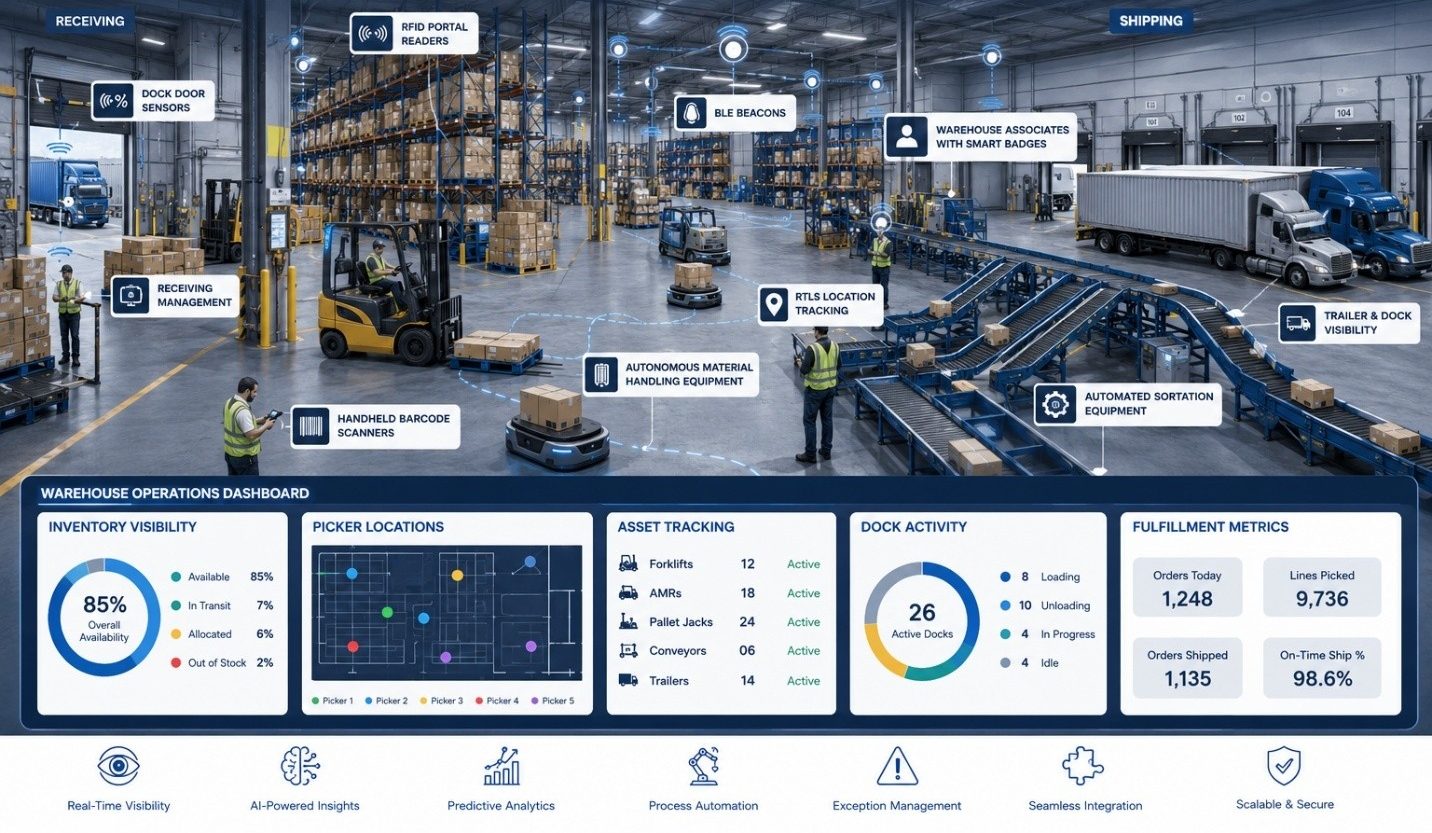
A premium enterprise illustration showcasing WareDist AI’s AI and IoT solution for warehouse and distribution operations. The visual highlights receiving docks, pallet storage, forklifts, autonomous material handling, RFID portal readers, BLE beacons, RTLS tracking, dock door devices, conveyor systems, automated sortation, warehouse associates with smart badges, loading trailers, and a real-time operations dashboard displaying inventory visibility, asset tracking, picker locations, dock activity, and fulfillment performance.
Applications Across Warehouse & Distribution Facilities
WareDist AI supports diverse warehouse environments where operational visibility and inventory accuracy directly affect customer service, operational costs, and supply chain performance. AI-driven monitoring enables warehouse teams to supervise activities occurring simultaneously across receiving, storage, picking, staging, packing, shipping, and returns processing.
Typical applications include
- Distribution centers
- Regional fulfillment centers
- E-commerce warehouses
- Third-party logistics facilities
- Cross-dock operations
- Spare parts warehouses
- Manufacturing warehouses
- Cold storage facilities
- High-density storage warehouses
- Automated sortation centers
Each deployment is configured according to warehouse layout, operational processes, inventory characteristics, workforce size, regulatory requirements, and integration needs.
Warehouse Workforce Systems
Warehouse personnel remain one of the most valuable operational resources within distribution facilities. Efficient workforce coordination improves picking productivity, enhances workplace safety, reduces unnecessary travel, and supports faster order fulfillment.
WareDist AI combines AI, BLE location services, wearable technologies, RTLS systems, RFID identification, and operational analytics to provide continuous visibility into workforce activities throughout warehouse operations. Rather than simply recording employee attendance, the system analyzes movement patterns, operational workflows, task completion rates, congestion points, and equipment interactions.
Warehouse supervisors gain operational visibility into picker assignments, travel paths, labor utilization, shift performance, aisle congestion, and workforce distribution across receiving, replenishment, picking, packing, and shipping zones. AI models analyze operational trends to identify process bottlenecks, excessive travel distances, underutilized labor resources, and opportunities for workflow optimization.
Examples of workforce capabilities include
- Real-time picker locationing
- Labor utilization benchmarking
- Forklift operator risk scoring
- Warehouse travel path analysis
- Aisle congestion detection
- Workforce productivity monitoring
- Zone occupancy visualization
- Shift performance analysis
- Visitor activity monitoring
- Contractor access verification
These capabilities help warehouse managers improve operational efficiency while supporting workplace safety and more effective labor planning.
Dock & Access Systems
Loading docks represent critical operational points where inventory enters and exits warehouse facilities. Delays, unauthorized access, scheduling conflicts, and equipment downtime can significantly affect warehouse throughput and transportation efficiency.
WareDist AI provides AI-powered dock management supported by connected devices, RFID identification, BLE credentials, access control technologies, and intelligent scheduling software. Dock activities are continuously monitored to improve trailer movement, dock utilization, workforce coordination, and shipment verification.
AI analyzes dock traffic patterns, trailer arrivals, loading durations, unloading performance, and yard movement to help warehouse operators reduce bottlenecks and improve dock utilization. Connected access systems verify authorized personnel entering restricted warehouse zones while maintaining complete audit records for operational compliance.
Operational capabilities include
- Dock door scheduling
- Restricted zone monitoring
- Yard-to-dock authorization
- Contractor and visitor screening
- Dock occupancy monitoring
- Trailer arrival verification
- Shipment movement visibility
- Loading sequence optimization
- Access credential validation
- Operational event recording
Warehouse operators can improve receiving efficiency, outbound shipping performance, and facility security while maintaining continuous operational awareness across every loading dock and controlled access point.
Material Handling Equipment Systems
Material handling equipment (MHE) is fundamental to warehouse productivity. Forklifts, pallet jacks, reach trucks, order pickers, tow tractors, dock levelers, and conveyor systems support the movement of goods throughout receiving, storage, replenishment, picking, packing, and shipping operations. Limited visibility into equipment location, utilization, maintenance status, and operator behavior can reduce productivity and increase operational costs.
WareDist AI combines AI and IoT technologies with RFID, BLE, RTLS, industrial devices, and edge software to provide continuous monitoring of warehouse equipment. Equipment movement, operating hours, idle time, travel routes, battery status, maintenance history, and utilization trends are collected in real time and analyzed to improve fleet efficiency.
Warehouse managers can identify underutilized equipment, reduce unnecessary travel, balance equipment assignments across shifts, and schedule maintenance before failures interrupt warehouse operations. AI also evaluates equipment usage patterns to support better fleet planning and capital investment decisions.
Material handling capabilities include
- Forklift utilization monitoring
- Pallet jack utilization analysis
- Returnable container recovery
- Mobile asset location tracking
- MHE predictive maintenance
- Dock equipment condition monitoring
- Battery charging optimization
- Equipment availability reporting
- Utilization benchmarking
- Equipment downtime forecasting
These capabilities help reduce unplanned downtime while maximizing the productive use of warehouse equipment throughout daily operations.
Inventory Visibility
Accurate inventory information is essential for maintaining customer service levels, reducing stock discrepancies, and supporting efficient warehouse operations. Large distribution centers often manage thousands of SKUs stored across multiple rack locations, picking zones, reserve storage areas, and staging locations. Manual inventory verification can be labor intensive and prone to errors.
WareDist AI applies AI and IoT technologies to improve inventory visibility through RFID identification, BLE asset tracking, handheld scanning devices, fixed reader infrastructure, industrial devices, and warehouse software integration. Inventory movements are automatically recorded as goods move through receiving, put-away, replenishment, picking, packing, and shipping processes.
AI analyzes inventory activity to identify abnormal stock movements, replenishment requirements, slotting opportunities, and cycle count discrepancies. Historical demand patterns and warehouse activity are also evaluated to support inventory planning and storage optimization.
Inventory management capabilities include
- SKU-level stock visibility
- Real-time inventory location
- Replenishment demand forecasting
- Slotting optimization analysis
- Cycle count variance detection
- Inventory movement history
- Storage utilization reporting
- Safety stock monitoring
- Inventory exception alerts
- Warehouse location verification
Improved inventory visibility supports faster order fulfillment, more accurate inventory records, and better warehouse planning while reducing manual inventory reconciliation.
Order Fulfillment Optimization
Customer expectations continue to increase for order accuracy, same-day fulfillment, and shipment visibility. Warehouse operations must coordinate inventory availability, workforce assignments, equipment utilization, and picking activities while maintaining high throughput and minimizing fulfillment errors.
WareDist AI supports order fulfillment by combining AI-driven operational analysis with connected warehouse devices and warehouse management software. Order progress is monitored throughout picking, packing, staging, and shipping to provide warehouse supervisors with real-time operational awareness.
AI evaluates warehouse activity to recommend improved wave planning, picker assignments, travel paths, replenishment timing, and workload balancing. Operational data collected from warehouse devices helps identify delays that affect fulfillment performance and customer delivery commitments.
Order fulfillment capabilities include
- Pick-pack cycle benchmarking
- Wave planning optimization
- Order throughput forecasting
- Picker workload balancing
- Packing station utilization
- Shipment staging visibility
- Order completion monitoring
- Shipping readiness verification
- Fulfillment exception reporting
- Throughput performance analysis
These capabilities support higher fulfillment accuracy, improved warehouse productivity, and more predictable shipping performance.
Warehouse Hardware Technologies
Reliable warehouse operations require dependable identification technologies, wireless communication, industrial devices, and edge devices capable of operating in demanding industrial environments. WareDist AI supports a broad range of hardware technologies that integrate with existing warehouse infrastructure while enabling AI-driven operational analysis.
Supported warehouse technologies include RFID portal readers for automated pallet identification, BLE beacons for personnel and equipment locationing, wearable badges for workforce visibility, dock door devices for shipment monitoring, and industrial IoT devices that collect operational data throughout warehouse facilities.
Additional technologies support yard management, trailer tracking, environmental monitoring, equipment health monitoring, and warehouse automation. AI software processes the operational data collected from these connected devices to improve visibility across inventory, assets, personnel, and warehouse activities.
Supported hardware technologies include
- RFID portal readers
- BLE beacons and tags
- Wearable picker badges
- Dock door devices
- AI and RFID pallet tracking
- AI and RFID cycle counting
- AI and RFID dock verification
- AI and BLE picker locationing
- AI and BLE aisle proximity monitoring
- AI and BLE forklift locationing
- AI and LoRaWAN yard tracking
- AI and Cellular trailer tracking
- AI and IoT motion devices
- AI and IoT load weight devices
These technologies provide the operational data necessary for AI systems to deliver continuous warehouse visibility and process optimization.
Warehouse Software Solutions
Connected hardware generates large volumes of operational information that must be organized, validated, and analyzed to produce actionable business insights. WareDist AI provides industrial software that manages warehouse devices, controls data collection, synchronizes operational information, and supports warehouse decision making.
Software modules simplify the administration of RFID infrastructure, BLE devices, RTLS systems, handheld scanners, serialization records, dock devices, and access credentials. Device health, communication status, firmware versions, operational alerts, and configuration settings are managed through centralized software.
Key software capabilities include
- RTLS tag provisioning software
- BLE beacon configuration console
- Warehouse zone mapping software
- Dock door device software
- Access credential provisioning software
- Yard gate alert routing
- RFID reader fleet management
- Handheld scanner integration software
- Pallet and asset registry software
- Lot serialization management software
- Compliance audit log software
Warehouse software integrates operational data from multiple technologies into a consistent data model that supports reporting, operational analysis, and integration with Warehouse Management Systems and Enterprise Resource Planning software.
Integration for Warehouse & Fulfillment Operations
Warehouse operations rely on numerous business systems that must exchange information accurately and continuously. Warehouse Management Systems (WMS), Enterprise Resource Planning (ERP) software, transportation systems, industrial automation equipment, RFID infrastructure, barcode scanners, BLE devices, and IoT devices all generate operational data that supports warehouse execution.
WareDist AI provides integration software that connects these technologies into a unified operational environment. Rather than replacing existing warehouse software, the solution exchanges operational data with established business systems while preserving existing warehouse processes.
Warehouse edge software collects information from RFID readers, BLE gateways, industrial devices, handheld scanners, dock door devices, and other connected equipment before securely transmitting validated data to warehouse software and enterprise applications. Data normalization processes help maintain consistent information across multiple technologies and device manufacturers.
Supported integration capabilities include
- Multi-device orchestration layer
- WMS interoperability middleware
- Device data normalization layer
- Cloud version deployment
- Server version deployment
- Hybrid edge deployment
- WMS real-time synchronization
- ERP data streaming layer
- Edge-to-cloud data pipeline
These integration capabilities allow warehouse operators to extend existing software investments while improving operational visibility across receiving, storage, fulfillment, and shipping activities.
Storage, Fulfillment & Distribution Applications
Warehouse environments differ considerably depending on product characteristics, inventory turnover, regulatory requirements, automation levels, and fulfillment strategies. WareDist AI supports multiple warehouse configurations through configurable AI and IoT systems that adapt to operational requirements rather than requiring standardized facility layouts.
Cold storage facilities benefit from continuous inventory visibility while monitoring environmental conditions and movement through temperature-controlled zones. High-density storage operations use RFID, RTLS, and BLE technologies to improve storage accuracy and reduce search times within narrow aisle configurations. Cross-dock facilities gain improved shipment coordination through dock monitoring, trailer verification, and synchronized receiving and outbound shipping activities.
Third-party logistics providers require visibility across multiple customers, inventory ownership records, and fulfillment workflows. Automated sortation centers use connected devices to monitor conveyor systems, routing equipment, and package movement. E-commerce fulfillment centers benefit from workforce visibility, picking optimization, and inventory accuracy that support high-volume order processing.
Typical deployment environments include
- Cold storage zone monitoring
- High-density rack operations
- Cross-dock facility operations
- Third-party logistics facilities
- Automated sortation centers
- E-commerce fulfillment centers
Each deployment is designed to support operational objectives while integrating with existing warehouse workflows and business software.
Why Organizations Choose WareDist AI
Organizations responsible for warehouse and distribution operations require reliable technologies backed by practical implementation experience. WareDist AI combines AI and IoT expertise with extensive knowledge of warehouse operations, industrial identification technologies, wireless communications, and enterprise software integration.
Built within Aperture Venture Studio with support from GAO, WareDist AI benefits from more than two decades of IoT experience. The technical foundation is based on work completed across thousands of IoT projects serving organizations operating warehouse, logistics, manufacturing, and industrial facilities. Continuous investment in research and development, structured quality assurance processes, and experienced engineering teams help ensure dependable system performance throughout implementation and ongoing operation.
Technical leadership includes Ph.D. professionals from leading universities working alongside specialists in RFID, BLE, RTLS, industrial networking, embedded systems, AI software, and warehouse operations. Experience gained through projects supporting Fortune 500 companies, leading research organizations, prestigious universities, and government agencies in the United States and Canada contributes to practical, real-world implementation knowledge.
Rather than focusing solely on software deployment, WareDist AI emphasizes measurable operational improvements through accurate data collection, dependable device integration, and AI-assisted operational analysis tailored to warehouse and distribution requirements.
Knowledge Center
Successful AI and IoT deployments depend on informed planning, technical understanding, and proven implementation practices. WareDist AI provides technical resources that assist warehouse operators, logistics professionals, system integrators, and engineering teams throughout evaluation, deployment, and operational improvement initiatives.
Available resources include
- Implementation documentation
- Deployment FAQs
- WMS integration guides
- Distribution center case studies
- RFID deployment recommendations
- BLE locationing best practices
- Warehouse integration documentation
- Technical white papers
- Industry compliance references
- Solution implementation examples
These resources help organizations evaluate technologies, understand deployment considerations, and develop implementation strategies that align with warehouse operational requirements.
Begin Your Warehouse Modernization Journey
Warehouse operations continue to evolve as customer expectations, fulfillment volumes, inventory complexity, and operational efficiency requirements increase. AI and IoT technologies provide practical methods for improving warehouse visibility, workforce coordination, inventory management, equipment utilization, and fulfillment performance without requiring organizations to replace their existing operational systems.
WareDist AI works with warehouse operators, distribution centers, logistics providers, manufacturing organizations, and supply chain professionals to develop AI and IoT solutions that align with operational objectives, existing infrastructure, and long-term business strategies. Whether the goal is improving picker productivity, increasing inventory accuracy, reducing equipment downtime, strengthening traceability, or enhancing warehouse decision making, our engineering teams help organizations identify practical technologies that deliver measurable operational improvements.
Contact our specialists to discuss your warehouse operations, evaluate AI and IoT opportunities, and explore solutions that support efficient, reliable, and data-driven warehouse and distribution management.
Contact Our Specialists